Showing posts with label Process. Show all posts

Chrono-Weigh H17E Aids Seed-Bagging Process

A provider of food, beverage and specialty chemical ingredients is using a Chronos BTH seed-bagging system. In summer 2009 the company had a requirement for a seed bagging system, which Chronos BTH supplied within six weeks of the sale. This bagging line incorporated a Chrono-Weigh H17E electronic bagging weigher. Operating on a gross weighing principle, the H17E is a fully automatic bagger with a pneumatically operated bag spout for manual bag-placing and is controlled by the SpeedAC NXT high-accuracy weighing controller.

Downstream of the H17E is a transfer conveyor with stitcher, bag kicker and manual palletising conveyor. Chronos BTH engineered the solution then installed and commissioned the simple bagging system in time for the customer to meet its obligations and pack the first batch of product on time. The Chrono-Weigh H17E automatic bagging weigher has a full-loadcell design and is suitable for bagging a range of free-flowing materials into various types of open-mouth bag. Compatible for existing H17 mechanical weigher installations, the H17E can be retrofitted without major modifications to existing support steelwork.

Symposium Focuses On Process Analysis

The International Society of Automation (ISA) is to host the 55th Analysis Division Symposium on 26-29 April 2010 at the Astor Crowne Plaza, New Orleans, US. This year's theme, 'Analytical Solutions in a Not So "Big Easy" Economic Environment', covers process analysis topics ranging from methods and applications to compliance, system operation, and maintenance. The event is sponsored by the ISA Analysis Division.

Formal published papers, informal reports, short courses, ISA training, speaker sessions, and panel discussions will focus on technology used in industry practice, as well as new technology currently in development. Chemical analysers, validation, system integration, and analytical hardware and software are all featured topics for the conference presentations. The three full conference days of the event offer attendees professional development hours. In addition, the ISA training course, 'Advances in Continuous Emission Monitoring', will offer continuing education units.

An Analysis Division training course, 'Fundamentals of Process Analyser Techniques', is also a part of the programme. Other highlights include vendor exhibits, a networking reception each night, and more. The symposium is endorsed by the Center for Process Analytical Chemistry, the Federation of Analytical Chemistry and Spectroscopy Societies, the Measurement and Control Engineering Center, the Air and Waste Management Association, and the US Environmental Protection Agency.

DTEC Applies Vclad To Chemical-Plant Process Tower

DTEC has completed a multi-column turnkey project at a chemical plant located on the east coast of the UK. The project focus was on the refurbishment of a stainless-steel process tower with a diameter of approximately three metres, which required a corrosion-resistant weld overlay CrNiMo-3 (Alloy 625) onto a stainless-steel base material. DTEC achieved this without incident, using Vclad Weld Overlay technology.

Vclad combines digitally controlled synergic welding technology with multi-directional programmable automation. The result is a high quality and productive weld-overlay process that can be applied to many repair and upgrade scenarios, ranging from replacement of original equipment design materials through to the application of corrosion-resistant alloys.

Weld procedures are qualified to both ASME and EN standards, and because DTEC holds a library of typical PQRs, it can react to unknown scopes often found during routine turnaround inspections. Due to the flexibility of the Vclad equipment, DTEC can work around many vessel internal restrictions, such as beam stools and tray-support rings. The consistency gained using an automated welding process ensures that a code-consistent weld chemistry is achieved while ensuring a highly productive weld overlay deposition is delivered.

DTEC is an all-encompassing column specialist that services the chemical and oil-refining industries. Its products and services cater for multiple and single-column events offering both mechanical services as well as equipment manufacture for emergency supply and equipment change outs, providing in-situ column or vessel refurbishment or material upgrades using its Vclad weld-overlay capability.

In this project, the workscope included: column isolations, opening external and internal manways for inspection, tray removal, removal and replacement of internal tower attachments, automated weld overlay, reinstallation of trays, close-column manways and de-isolations.

Hybacs Process Performs Well In Pilot Trials

Bluewater Bio International has announced that its Hybacs process is continuing to show high performance in independent pilot trials carried out by Severn Trent Water in the UK and Aqualia in Spain. Both pilot trials are ongoing but at different stages. The collaboration with Severn Trent Water, which began the trial earlier, is now progressing with consideration being given to the potential of a full-scale installation.

Results from pilot plants installed at operational sites managed by Severn Trent Water and Aqualia verify that the Hybacs (hybrid bacillus activated sludge) process can remove nutrients from municipal-type wastewaters to comply with European regulations. More specifically, the plans have demonstrated Hybacs' efficacy in removing ammonia, nitrogen and phosphorus (key indicators of nutrient levels) to levels that comply with the general requirements of the sensitive area regulations in the European Union Urban Wastewater Treatment Directive.

Severn Trent Water sewage treatment works in Coleshill, near Birmingham, treats municipal wastewater containing discharges from a light industry park. Over the course of 10 weeks from June to August 2009, the Hybacs plant removed more than 97 per cent of ammonia and more than 70 per cent of TN (total nitrogen), with TN removal levels in the final week peaking at an average of 93 per cent.

Similarly, the Aqualia plant has demonstrated more than 90 per cent removal of TP (total phosphorous) over recent weeks. Hybacs plants can achieve this performance while reducing power consumption by at least 40 per cent, according to Bluewater Bio International. In addition to power savings, the Hybacs process offers Capex reductions of up to 30 per cent, and a land-area footprint reduction of up to 40 per cent compared with conventional treatment technologies. Hybacs' modular format is said to be ideal for upgrading existing plants since generally all of the existing infrastructure can be leveraged for use in the Hybacs plant.

In most circumstances, Hybacs eliminates the need for water companies to construct large additional tanks of the type needed to upgrade conventional treatment plants to deliver nutrient removal performance. Hybacs can also be used to upgrade the general treatment capacity of conventional plants. Following the trials, Bluewater Bio is undertaking feasibility work with Severn Trent regarding the potential implementation of the Hybacs process within its region.

Process Analyser Offers Application Flexibility

The Applikon Analytical ADI 2040 process analyser from Metrohm is a multipurpose wet chemical analyser designed to offer flexibility and withstand harsh environments. The analyser uses techniques including titration, colorimetry and dynamic standard addition with ion-selective electrodes. The analyser's rugged hardware and the possibility to do automatic calibration and cleaning result in a 99.5 per cent up-time, according to Metrohm.

Its versatility allows the incorporation of multiple analyses and multiple sample streams on one analyser, resulting in low cost per analysis/sample. The controller makes it possible to run up to three independent analyses simultaneously. Reagent usage is minimised by using low-volume measuring cells. The ADI 2040 has a modular wet part with 20 uniform positions for a variety of modules and accessories. It can be adapted to almost any application.

In the electronic part, the same modular concept is used, so that the I/O cards for control of the wet part and external communication (maximum 20) can be configured to the needs of the user. The ADI 2040 can be loaded with several analysis packages by flash card and can therefore be adapted to specific process analysis requirements. The ADI 2040 can handle four (different) electrodes or sensors; extension to eight is possible. The possibility to choose a combination of methods means that in many cases one single ADI 2040 will fulfil all analysis requirements.

ACI De-Duster Allows Safer Clean-Down Process

An Air Control Industries (ACI) Jetblack personnel de-duster has replaced a dangerous compressed air cleaning process at a Steetley Dolomite works. The Whitwell Works of Steetley Dolomite quarries and produces magnesium limestone products for the steel, refractory and agricultural industries. After the limestone is quarried, it is crushed, sized and processed to produce various products for applications such as steel furnace manufacture and repair, steel production, refractory products and agricultural soil improvement.

The processing of the limestone to produce these products results in the creation of a lot of dust around the plant, which gets deposited on the overalls of workers on site. To de-dust themselves, although advised frequently not to because of the very real danger that it poses, many of the staff would clean their overalls down with compressed air. Posters about the risks and verbal warnings from the safety leader for compressed air, John Collins, seemed to do little to deter them from the practice. That situation has now changed since Collins had a blower powered Jetblack personnel cleaning unit from Air Control Industries (ACI) of Chard installed on trial after an on-site demonstration.

The trial, which started in February, proved successful and because of the appreciation throughout the plant for its safety and ease of use, Collins has had second unit installed. 'Everyone is pleased with the ACI Jetblack,' said John Collins, Steetley Dolomite's senior electro technician. 'It cleans down effectively and is safe. It eliminates all the health hazard risks present when using compressed air. By providing the Jetblack as an alternative we have broken the bad practice of using compressed air for cleaning down,' he added.

The blower-powered Jetblack delivers high volumes of air at low pressure that can even be applied directly onto exposed skin. There are none of the risks of associated with compressed air, while still achieving effective personnel cleaning. In addition, the ACI Jetblack is quiet (78dBA) and cost effective to run, only using energy on demand with no drain on compressor power. The Jetblack is available as either a wall-mounted or portable unit. Operation is by a hand-held gun on a flexible hose.

Insertion Probes Monitor Bioproduction Process

Stratophase has collaborated with the Centre for Process Innovation (CPI) to develop an insertion probe variant of its Spectrosens system. Enabling real-time monitoring of the bioproduction fermentation process, the multi-output Spectrosens insertion probes track compositional changes and monitor temperature in the liquid.

Multiple discrete readings can be taken simultaneously at numerous locations, providing more reliable measurements and a reduced chance of false positives. As a result, the entire fermentation process can be precisely monitored to ensure reproducibility and clear determination of the desired end-point. The Spectrosens system sensors can be placed throughout the production process and networked via the control and analysis unit.

Using only light at the point of measurement, the sensors are intrinsically safe and spark free, removing any chances of ignition. The insertion probe fits standard ports for dissolved oxygen (DO) and pH probes, enabling ultra-high resolution, optical microchip technology to be applied to existing benchtop and large-scale bioreactor equipment. Other tried and tested applications of the Spectrosens insertion probe include biofuel production and sustainable polymer development. The probe system is currently being trialled at the UK's National Industrial Biotechnology Facility (NIBF).

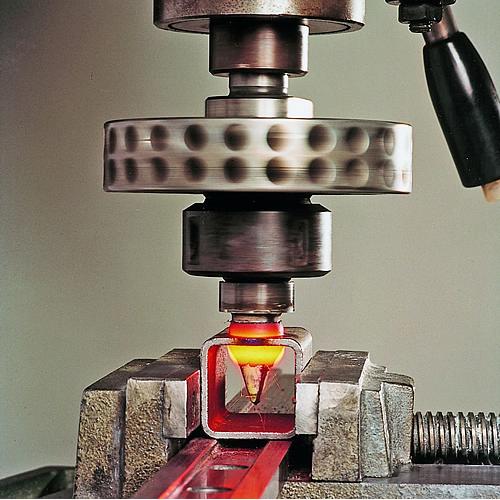
Formdrill Process Uses Friction Heat To Drill

The Formdrill process uses a special carbide tip to drill through thin materials such as sheet metal using friction, removing the need for nuts and bosses. The Formdrill process involves a carbide conical tip (Formdrill) that heats up the material by friction into a super-plastic state, enabling the Formdrill to push through and form the hole and displace the material into a bushing that generally triples the material thickness.

This additional wall surface is then threaded, eliminating the need for welded nuts, bosses or inserts. This bushing is also used as support for brazing or as a bearing wall in rotating shaft applications. It can be used on most drill presses, milling machines or CNC systems. The only parts required are a tool holder, a collet and the Formdrill. Each Formdrill will perform from 8,000 to 10,000 cycles in mild steel, a little less in stainless steel, and more in aluminum and copper.

This process is claimed to have the ability to reduce costs from 50 per cent to 90 per cent when compared to conventional methods. The savings come from the fact that overall cycle times are reduced and consumable costs are almost eliminated. There is virtually no post-process cleanup. The joints created are said to have exceptional torque and pull-out strength values that equal or excel the welded nut equivalents.

SMAC Creates Tapping Process For Watch Maker

SMAC has developed a linear/rotary actuator, the LAR35 series, as a tapping process for a watch manufacturer in Switzerland. The tap diameter is 0.38mm; the part has a diameter of 3mm and is 0.25mm thick. The LAR35 series has a 50mm stroke and is mounted vertically with the shaft looking down. The custom tip is attached to the shaft end of the actuator to hold the tap.The shape of the parts can be varied so that the customer can hold the part to tap manually, while the fixture is being developed.

SMAC's patented soft-land capability allows the tool to land on the part gently, move back 0.1mm, start the rotation, press the linear axis with a small force, check any variation on torque on the rotary motor to avoid failure and check the linear position when the tap reaches the required position. The same procedure takes place in reverse. For the SMAC LAR series, linear and rotary are combined in one unit. With all SMAC actuators, force, speed and position are fully programmable.

Precision Micro Develops Etching Process

A team at Precision Micro has developed a process to make Elgiloy, an austenitic super alloy, 'etchable'. Elgiloy is based on cobalt and is an erosion and corrosion-resistant stainless steel. Photo etching is a manufacturing technology that produces intricate, burr free, stress free, high-precision profiles by a process of controlled erosion. On the face of it, Elgiloy and photo etching should be incompatible.

This was the case until the process development team at Birmingham-based Precision Micro came up with a process route that the company claims has solved the problem. 'The solution does not just involve a combination of etchant chemicals,' said Bob Crutchley, director. 'A methodology has been developed, whereby a treatment is applied prior to etching and a catalyst is introduced during the etching process itself,' he added.

The process utilises standard photo resist materials and chemicals that have no exceptional hazard risk. It is designed to enable engineers to utilise Elgiloy in a wider range of applications in the medical, aerospace, automotive and advanced engineering industries. Elgiloy offers high corrosion resistance, temperature resistance and high elasticity modulus.

GE Fanuc Scales Down Proficy Process Systems

GE Fanuc Intelligent Platforms has released Proficy Process Systems in a 250 I/O size, single-computer offering targeted at smaller applications and OEMs. Proficy Process Systems is a fully-integrated process control system that can provide customers with improved quality and reliability, increased throughput, performance and efficiency and reduced total cost of ownership.

The foundation of Proficy Process Systems is a contemporary hardware and software infrastructure that offers the benefits of traditional DCS and PLC/HMI systems, without many of the historic limitations of those approaches. Proficy Systems is also packed with control features including a comprehensive set of function blocks for advanced regulatory control.

In addition, user-defined function blocks can be created for the freedom and flexibility to define control algorithms as necessary, which system integrators can lock to protect their intellectual property. Proficy Process Systems supports Foundation Fieldbus, Profibus DP and PA, Hart and Ethernet.

Software Automates Publishing Process

InnoCielo Publisher and its modules make it possible to automate the publishing process, triggered by predefined document lifecycle events or on an ad-hoc basis. BlueCielo ECM Solutions has released InnoCielo Publisher 2008, the latest version of the optional Publisher add-on for the InnoCielo Meridian Enterprise ECM solution. InnoCielo Meridian Enterprise automates the rendering and publishing of engineering content. In the publishing process, engineering documents are rendered into universally readable formats and stored in a target system such as a Windows folder, an FTP site, Microsoft SharePoint, Documentum or InnoCielo Meridian Enterprise itself.

InnoCielo Publisher and its modules make it possible to automate the publishing process, triggered by predefined document lifecycle events or on an ad-hoc basis. InnoCielo Publisher is used with InnoCielo Meridian Enterprise by companies such as Areva TandD Systems, Huntsman, Johnson Controls, Pfizer and Siemens in energy/utilities, manufacturing, oil and gas, petrochemical, pharmaceutical and other vertical markets. "InnoCielo Publisher is a useful extension to InnoCielo Meridian Enterprise which we currently use to manage about 280,000 technical documents".

"InnoCielo Publisher provides us with a standard approach to the high-volume printing of our project documentation and integrates with our system to produce neutral PDFs for easy distribution", said Alan Painter, Business Manager - Secondary Systems of Areva TandD Systems. "With InnoCielo Meridian Enterprise at the front end, InnoCielo Publisher operates invisibly in the background and sends our publishing requirements to our servers in a wholly automated process, cutting out the need for manual, time-consuming effort".

"InnoCielo Publisher and its additional modules make it much easier for organisations to distribute information to departments outside of Engineering in neutral, accessible file formats". "Approved documents are also available to collaboration partners at the right time through the right medium", adds Martijn Janmaat, BlueCielo's CEO. "With the entire information exchange process being automated, companies will experience benefits such as shorter turnaround times, greater efficiency and better protection of their intellectual property if external parties are involved".

InnoCielo Meridian Enterprise users can access the publishing queue from the PowerUser or OfficeUser desktop clients, allowing publishing jobs to be viewed, restarted and cancelled. The Generic PDF Rendering module can render documents in most popular CAD (AutoCAD, Autodesk Inventor, MicroStation, SolidWorks), Microsoft Office (Word, Excel, PowerPoint, Visio, TXT, HTML), image (JPG, PNG, RLC, BMP, TIF, PCX) and fax (CAL, GP4, MIL, RAS) formats into the standard Adobe PDF format.

InnoCielo Publisher can be run from all supported Windows operating system environments, including Windows Vista. Tracing, logging and error handling have been enhanced to greatly improve stability and traceability. The optional PDF Merge module allows multiple documents in different source formats and linked by references or properties to be consolidated into a single PDF rendering. This is particularly useful for documents such as assemblies and sets of project documentation.

The optional Developer module allows one to develop and use custom rendering and publishing options. This module, in combination, with the InnoCielo Publisher Standard Edition replaces the InnoCielo Publisher Framework. In addition to the new modules above, standard InnoCielo Publisher modules are available for native rendering from AutoCAD, Inventor and Microsoft Office and for publishing to InnoCielo Meridian Enterprise, the Windows file system and SmartZIP.