Showing posts with label Friction. Show all posts

Homemade Z80 COMPUTER running elementary BASIC language

Homemade Z80 COMPUTER running elementary BASIC language Video Clips. Duration : 5.83 Mins.


Hi, I finally wrote a Basic language for my Z80/AM95 8-bit NANO COMPUTER in order to easily program it. I called it "8BASIC" because everything must clearly fit the 8 digit LED display. The video shows all commands and statements, plus two famous benchmarks vs. contemporaneous 1970's-80's computers. Due to the strong mathematical support of the AM9511 math processor, the BASIC interpreter runs reasonably fast for a 2.5 MHz machine, offering seven significant digits floating-point arithmetic. Everything you see in the video is the result of almost three years of work (or fun?!). All data reproduced in the video are for educational and non-commercial purpose, following fair-use guidelines. Music is royalty-free (Kevin MacLeod: "Pinball Spring"). GG, Italy -- 2011 ____________________________________ DESCRIPTION: ◦ Manufacturer: homemade by GG ◦ Model's name: Z80/AM95 8-bit NANO COMPUTER ◦ Typology: training microcomputer ◦ Number produced: 1 ◦ Country of Origin: Italy ◦ Year: 2008-2010 ◦ Style: vintage 1980's original components on perfboard ◦ Price: VideoDescription -- (Not for sale) ◦ Ultimate aim: hobby and recreation, educational, chip-oriented retrocomputing, DIY electronics, 'Homebrewing' (designing and building of retro-styled computers) ____________________________________ SPECIFICATIONS: ◦ Processor: Zilog Z80 (Mostek MK3880P-10 8 bit CPU, ceramic purple, 2.5 MHz, -40° to +85°C) ◦ CPU Datacode: 1980 ◦ CPU Speed: 2.5MHz ◦ Co-processor: AMD AM9511 (Intel C8231A 16 bit ...

Tags: z80, am9511, z-80, 9511, 8231, diy, homemade, cpu, computer, basic, programming, language, homebrew, retrocomputing, retrocomputer, 1980'S, 1970'S, Z80/AM95, 8-bit, nano, microcomputer, electronics, electronic, coprocessor, microprocessor, 8basic, 8bit, digital, display, led, zilog, intel, amd, 8080, vintage, chips, dip, circuit, integrated, ttl, 8bits, hobby

Ball Bearings Offer Reduced Noise And Friction

Schaeffler's Generation C deep groove ball bearings offer 35 per cent less friction and 50 per cent less noise than their predecessor. The bearings also benefit from more effective sealing and a riveted steel cage. The design improvements mean that Schaeffler's Generation C FAG deep groove ball bearings can achieve higher running speeds and efficiencies, while simultaneously increasing the life of the bearing and reducing energy consumption.

In order to minimise friction, Schaeffler optimised the osculation (raceway curvature) between the balls and rings on the Generation C bearings. This means there is less chance of misalignment between the inner and outer ring. As well as offering 35 per cent less friction, the bearings generate less heat, making them suitable for higher running speeds. The bearings are therefore suitable for applications in which low noise and smooth running are critical, for example, electric motors, power tools, ventilators and washing machines, where reduced friction and improved energy efficiency of the bearings lead to a reduction in operating costs and a more efficient machine with extended maintenance intervals.

Schaeffler has also modified the seal on the Generation C bearings. The HRS seal has modified double lip geometry and is made from nitrile butadiene rubber. They are adjusted to match the recess on the bearing inner ring. Axial contact between the inner ring and the seal means more effective protection against contamination or loss of grease and less frictional torque. This results in longer grease life, increasing the life and reliability of the bearing and provides improved bearing performance at higher speeds (rpm).

Venting grooves have also been added in order to improve the run-in behaviour of the bearings. In addition to the HRS seal, the bearing shield has been modified. The recesses on the bearing rings and the shield geometry are functionally adjusted to each other in such a way that the sealing efficiency is improved and grease life increased. This design creates an axial and radial labyrinth with the shield. The improved guidance of the rolling elements also contributes to higher performance of the bearing.

The riveted steel cage, which replaces the previous steel 'ribbon' cage, offers higher rigidity and is suitable for higher running speeds. The riveted steel cage also reduces noise levels and means the bearing is less sensitive to shock loads. The manufacturing tolerance of the bearings has also been increased (to P5 Abec 5 standards), ball roundness to G5 tolerances and improved surface finish. The dimensions of the new bearings correspond to the previous bearing types, enabling easy replacement.

Generation C bearings can operate in temperatures from - 30C up to +120C. They are available with outside diameters from 26mm up to 90mm. Riveted steel cages are standard, although polyamide cages are optional. P6 or P5 tolerances can be specified on ordering. Sealing options include one or two gap seals; one or two lip seals; or low friction, non-contact labyrinth seals.

Formdrill Process Uses Friction Heat To Drill

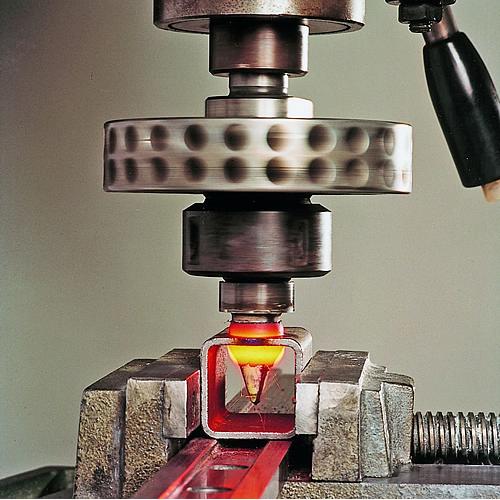
The Formdrill process uses a special carbide tip to drill through thin materials such as sheet metal using friction, removing the need for nuts and bosses. The Formdrill process involves a carbide conical tip (Formdrill) that heats up the material by friction into a super-plastic state, enabling the Formdrill to push through and form the hole and displace the material into a bushing that generally triples the material thickness.

This additional wall surface is then threaded, eliminating the need for welded nuts, bosses or inserts. This bushing is also used as support for brazing or as a bearing wall in rotating shaft applications. It can be used on most drill presses, milling machines or CNC systems. The only parts required are a tool holder, a collet and the Formdrill. Each Formdrill will perform from 8,000 to 10,000 cycles in mild steel, a little less in stainless steel, and more in aluminum and copper.

This process is claimed to have the ability to reduce costs from 50 per cent to 90 per cent when compared to conventional methods. The savings come from the fact that overall cycle times are reduced and consumable costs are almost eliminated. There is virtually no post-process cleanup. The joints created are said to have exceptional torque and pull-out strength values that equal or excel the welded nut equivalents.

Ball Bearings Offer Reduced Noise And Friction

Schaeffler's Generation C deep groove ball bearings offer 35 per cent less friction and 50 per cent less noise than their predecessor. The bearings also benefit from more effective sealing and a riveted steel cage. The design improvements mean that Schaeffler's Generation C FAG deep groove ball bearings can achieve higher running speeds and efficiencies, while simultaneously increasing the life of the bearing and reducing energy consumption.

In order to minimise friction, Schaeffler optimised the osculation (raceway curvature) between the balls and rings on the Generation C bearings. This means there is less chance of misalignment between the inner and outer ring. As well as offering 35 per cent less friction, the bearings generate less heat, making them suitable for higher running speeds. The bearings are therefore suitable for applications in which low noise and smooth running are critical, for example, electric motors, power tools, ventilators and washing machines, where reduced friction and improved energy efficiency of the bearings lead to a reduction in operating costs and a more efficient machine with extended maintenance intervals.

Schaeffler has also modified the seal on the Generation C bearings. The HRS seal has modified double lip geometry and is made from nitrile butadiene rubber. They are adjusted to match the recess on the bearing inner ring. Axial contact between the inner ring and the seal means more effective protection against contamination or loss of grease and less frictional torque. This results in longer grease life, increasing the life and reliability of the bearing and provides improved bearing performance at higher speeds (rpm). Venting grooves have also been added in order to improve the run-in behaviour of the bearings.

In addition to the HRS seal, the bearing shield has been modified. The recesses on the bearing rings and the shield geometry are functionally adjusted to each other in such a way that the sealing efficiency is improved and grease life increased. This design creates an axial and radial labyrinth with the shield. The improved guidance of the rolling elements also contributes to higher performance of the bearing. The riveted steel cage, which replaces the previous steel 'ribbon' cage, offers higher rigidity and is suitable for higher running speeds.

The riveted steel cage also reduces noise levels and means the bearing is less sensitive to shock loads. The manufacturing tolerance of the bearings has also been increased (to P5 Abec 5 standards), ball roundness to G5 tolerances and improved surface finish.

The dimensions of the new bearings correspond to the previous bearing types, enabling easy replacement. Generation C bearings can operate in temperatures from - 30C up to +120C. They are available with outside diameters from 26mm up to 90mm. Riveted steel cages are standard, although polyamide cages are optional. P6 or P5 tolerances can be specified on ordering. Sealing options include one or two gap seals; one or two lip seals; or low friction, non-contact labyrinth seals.