'This massive - but still compact - welded heat exchanger offers a unique energy efficiency especially well suited for the high demands within the refinery and petrochemical industries,' said Lars Renstrom, president and chief executive officer of the Alfa Laval Group. Delivery is scheduled for 2011.
Interfaces | Microsemiconductor | Semiconductor | Conductor | Macro Conductor | Micro Conductor | Electrical Parts | American Microsemiconductor | Circuits | Transistor | Diode | Digital | Analog | Micro Controler | Electrical Conductor | Electrical Interfaces | AMS | IC | CMOS | NMOS | Silicon Transistor | Microprocessor | Processing | Integrated Circuits
Showing posts with label Heat. Show all posts
Refinery Orders Heat Exchangers From Alfa Laval
'This massive - but still compact - welded heat exchanger offers a unique energy efficiency especially well suited for the high demands within the refinery and petrochemical industries,' said Lars Renstrom, president and chief executive officer of the Alfa Laval Group. Delivery is scheduled for 2011.
Powerline Plus Converters Feature Heat Sink
The main features are: high efficiency and low standby current; case temperature operating range of -45C to +120C; built in FCC/EN55022 Class B EMC filter; high galvanic isolation up to 3KV DC; guaranteed start-up at -45C; compact size; low-weight case; industry-standard pin-outs; and a six-sided shielded enclosure with integrated heat sink. Due to the high efficiency, the converters offer a substantial cost saving when compared with equivalent specialist converters.
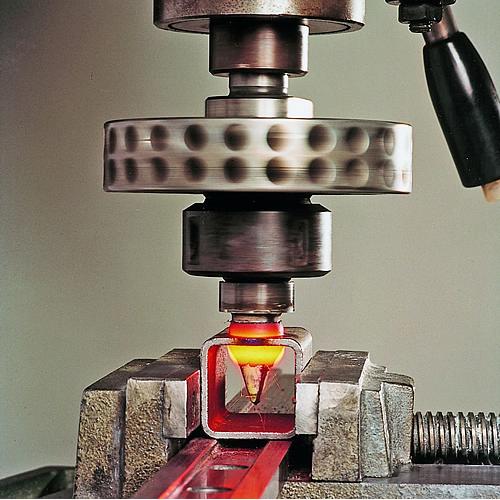
Formdrill Process Uses Friction Heat To Drill
This additional wall surface is then threaded, eliminating the need for welded nuts, bosses or inserts. This bushing is also used as support for brazing or as a bearing wall in rotating shaft applications. It can be used on most drill presses, milling machines or CNC systems. The only parts required are a tool holder, a collet and the Formdrill. Each Formdrill will perform from 8,000 to 10,000 cycles in mild steel, a little less in stainless steel, and more in aluminum and copper.
This process is claimed to have the ability to reduce costs from 50 per cent to 90 per cent when compared to conventional methods. The savings come from the fact that overall cycle times are reduced and consumable costs are almost eliminated. There is virtually no post-process cleanup. The joints created are said to have exceptional torque and pull-out strength values that equal or excel the welded nut equivalents.
Coating Inhibits Transfer Of Heat From Exhausts
Automobili Lamborghini has selected Zircotec to supply a thermal barrier for the lightweight Murcielago LP 670-4 SuperVeloce (SV). The ceramic-based thermal coating is applied to the SV's lighter exhaust system, and inhibits heat transfer from the exhaust pipe, protecting heat-sensitive components from damage.
Zircotec's zirconia-based ceramic coating offers OEMs a robust, easily packaged solution that can inhibit the transfer of heat from exhausts and catalysts, retaining the heat inside the system to protect surrounding components. The coating is plasma-sprayed, in effect welding it to the base material, making it more resilient during heat cycling, abrasion and life testing.
The process eradicates the need for heatshields and wraps that add weight and complexity.
Zircotec can 'tune' the coating's thickness to cope with 'hot spots', applying the optimum amount of ceramic to minimise weight (as low as 0.03g/cm for some applications).
Zircotec's zirconia-based ceramic coating offers OEMs a robust, easily packaged solution that can inhibit the transfer of heat from exhausts and catalysts, retaining the heat inside the system to protect surrounding components. The coating is plasma-sprayed, in effect welding it to the base material, making it more resilient during heat cycling, abrasion and life testing.
The process eradicates the need for heatshields and wraps that add weight and complexity.
Zircotec can 'tune' the coating's thickness to cope with 'hot spots', applying the optimum amount of ceramic to minimise weight (as low as 0.03g/cm for some applications).
Rittal Develops Air-To-Air Heat Exchanger
Rittal has developed an air-to-air heat exchanger that has been specifically tailored to care for the needs of the mobile railway engineering industry. Available in both 24V DC and 110V DC versions, the exchangers have been constructed to EN 50 155 and vibration tested to EN 61 373.
Offering long-term reliable cooling, the exchangers extract heat from inside the enclosure to the surrounding environment, using only two working parts. Two fan motors housed inside the exchanger control the internal and external airflows independently. The exchanger matrix, made from aluminium, is light but durable and spray-finished in RAL 7035 to DB TL 918340.
Air-to-air heat exchangers offer a simple platform for servicing. Filter amts are available for dirty environments as well as a matrix module, which can easily be removed for cleaning with compressed air in less than five minutes. Quick connect plug electrical connections and the modular constructed fans allow fast serviceability and rapid replacement of parts in the event of failure.
Digital controllers monitor the internal temperature so if an enclosure reaches a pre-determined set point an alarm is displayed. A fault signal can also be sent via a floating contact.
Alloy Resists Heat And Corrosion
Etching is a controlled corrosive process and Inconel has been developed with a high nickel and chromium content, specifically to resist corrosion. The Inconel 617 nickel-chromium-cobalt-molybdenum superalloy offers excellent high-temperature strength and oxidation resistance It also exhibits excellent resistance to a wide range of corrosive environments, which to date have largely prevented the material being photo etched
Etching is a controlled corrosive process and Inconel has been developed with a high nickel and chromium content, specifically to resist corrosion.
Processing thin sheet Inconel by conventional means (punching and slitting) has always given cause for concern as parts tend to come out wavy and the material has a tendency to roll at the edges after processing. Now, thanks to this by the Precision Micro Technical Team, perfectly flat, precision parts can be produced from 0.006in Inconel sheet, economically and with outstanding repeatability.
Etching is a controlled corrosive process and Inconel has been developed with a high nickel and chromium content, specifically to resist corrosion.
Processing thin sheet Inconel by conventional means (punching and slitting) has always given cause for concern as parts tend to come out wavy and the material has a tendency to roll at the edges after processing. Now, thanks to this by the Precision Micro Technical Team, perfectly flat, precision parts can be produced from 0.006in Inconel sheet, economically and with outstanding repeatability.
Subscribe to:
Posts (Atom)