Showing posts with label Launches. Show all posts

Minitec Launches Profile Systems Reference Guide

Minitec UK has compiled and written a 72-page reference guide on machine framing system design and applications. The pocket-sized hard copy book is entitled 'Profile Systems for Mechanical Engineering' and covers a range of information from materials analysis and structural design considerations to time and cost benefits for extruded aluminium systems versus traditional steel fabrication.

'Profile Systems for Mechanical Engineering' takes a broad view to help machine builders make considered decisions about materials selection, structural design, adaptability of profile systems, application diversity, fastening technologies and design software.

An applications section covers some real examples in different fields of mechanical engineering where Minitec's Profile System has enabled shortened design and assembly times and reduced development costs for fully modular and easily scaled machine designs

KIC Launches Spectrum Thermal Prediction Software

KIC Thermal Profiling has unveiled its Spectrum thermal process optimisation software: the third and final link to the company's range of technologies for increased solar-cell efficiencies. According to the company, the solar-cell manufacturing industry links higher cell efficiency to the ability to manufacture the solar wafers in the 'sweet spot' of the thermal process window.

Spectrum automatically identifies the correct furnace setup that achieves a thermal profile that is positioned within the 'sweet spot' of the established process window. The prediction software uses the information from a single profile pass to evaluate the millions of possible furnace setups. Each possible furnace recipe will yield a profile and Spectrum identifies the fit between the profile and the established process window. Within seconds, the software can complete a ranking and present its recommendation for the furnace recipe (zone temperatures and conveyor speed) that yield the optimal profile. Spectrum is a software-only option for the SunKIC profiler.

All PSU Launches AQF240 Series Of Power Supplies

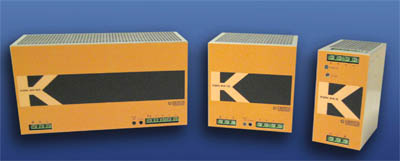
All PSU has launched a range of ultra-compact high-efficiency 240W power supplies. The AQF240 series of power supplies is available with the option of either a fully enclosed case or a U-channel chassis. All units are in a compact case size of 150mm x 106mm x 35mm for both enclosed and U-channel versions and have screw terminal connections for input and output.

The AQF240 series also benefits from full-range universal AC input and a high efficiency of up to 93 per cent, which enables the power supplies to be convection cooled to full power at up to +50C. All units have full international safety approvals and come with a two-year warranty.

KIC Launches Second-Generation Wave Surfer

KIC, a provider of thermal process development and control products, has released the second-generation Wave Surfer: a self-contained measurement system for wave solder machines. The system provides critical data on wave solder machine setup and its process. As a wave solder machine profile fixture, Wave Surfer features five embedded thermocouples and works in conjunction with a KIC profiler to facilitate profiling and wave solder machine setup.

Made of a material similar to typical wave solder pallets, Wave Surfer can withstand thousands of passes. The fixture holds the profiler in place during each run to measure the pertinent process data in the wave solder machine, including peak temperature, dwell time, parallelism and conveyor speed.

Kepco Launches DIN-Rail Power Supplies

Kepco has launched the KDN series of low-cost, UL-508 listed, DIN-rail mounted power supplies. The series consists of three 24V output models rated at 5, 10 and 20A.

The KDN series offer 90-264VAC input with PFC, 23-28V adjustment range and a 120 per cent peak-current capability for up to one minute with no forced air cooling required.

Aaeon Launches ETX-CX700M Product

Aaeon has announced the ETX-CX700M - an Embedded Technology Extended (ETX) product based on the VIA C7/Eden (V4) series processors combined with the VIA CX700M chipset. The ETX-CX700M provides support for a multitude of expansion and storage interfaces that will allow for numerous options to be designed onto the baseboard. The module is available with either the VIA Eden 1.6GHz processor or the VIA C7 2.0 GHz processor and features support for one 200-pin DDRII 400/533 RAM at a maximum capacity of 1GB.

It has support for four 32-bit PCI buses, one 8-bit/16-bit ISA bus, one SMBus, and one I2C bus that enable the customers to expand on their systems without the extra cost of hubs. For Ethernet support, the ETX-CX700M features the Realtek RTL8139DL 10/100Mb Ethernet chipset with the option for customers to change to the Intel 82551QM 10/100Mb chipset as needed for their application.

Video support is handled by the VIA CX700M chipset and can provide resolutions up to 1,600 x 1,200 on a 24-bit dual-channel LVDS LCD panel, as well as a CRT monitor. The module supports simultaneous and dual-view output to CRT/LVDS, LVDS/TV, CRT/DVI or TV/DVI. The integrated video on the board can share up to 128MB of system memory for use as video memory and it supports an MPEG-4 accelerator.

Storage support is available by means of two SATA II connectors on the ETX-CX700M as well as with support for one PATA channel and Compactflash on the carrier board. The ETX-CX700M aims at markets such as test and measurement, gaming and entertainment, industrial automation, military, government and security.

Bulte Launches Self-Locking Nylon Nuts

Bulte Plastics has launched a series of plastic self-locking nuts. The lock nuts are suitable for applications that require extra security as they eliminate backlash without sacrificing efficiency. The company said this type of nut is more effective than standard hex nuts because it includes a no-threaded part that closes around the thread, creating a lock between the two threads.

Self-locking nuts are being used as a secure fastening nut for joining many kinds of parts. They are manufactured from natural Polyamide 6.6 that, when combined with steel screws, provides low drag torque and smooth operation throughout the life of the assembly (preferably not reusable). They also save weight over the conventional steel/nylon lock nuts.

The cost-effective plastic nuts are used in a variety of industrial applications, including: electronic and electrical equipment; construction; furniture; and medical industries; which require properties such as strength, corrosion resistance, oil resistance, low weight alternatives and low thermal conductivity. The working temperature range is -30C to +100C. Metric sizes include M5, M6, M8, M10 and M12. The self-locking nuts can also be supplied in PP, PE and PVDF (these materials are recommended for their food and medical qualities) and in a range of colours.

Npower Launches 6.0 Release Of Power Products

Npower Software has announced the 6.0 release of its Power NURBS, Power Solids, and Power Translators products (with support for Autodesk 3ds max 2010 and Autodesk 3ds max Design 2010). Version 6.0 of Npower Software's Power NURBS, Power Translators, and Power Solids products includes tighter integration with Autodesk 3ds max, with direct support for Autodesk 3ds max modifiers.

Users can now directly apply bend, displace, noise, ripple, skew, twist, taper, and other modifiers onto Npower plug-in objects. These modifiers can be applied to imported geometry (and then even exported back to the system in which they were created), and to Power NURBS/Solids objects created within Autodesk 3ds max.

Power NURBS, Power Solids and Power Translators empower artists, designers, and engineers around the world by providing advanced tools for designing, conceptualising, and rendering intricate, complex geometry.

NI Launches EVS-1464RT Embedded Vision System

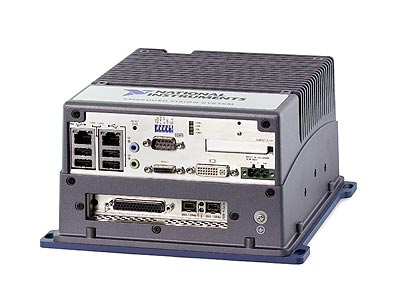
National Instruments (NI) has released an embedded vision system that gives manufacturing engineers and system integrators the ability to build high-speed real-time machine vision systems. These machine vision systems can be built for applications such as sorting products, verifying assembly and inspecting packaging. The NI EVS-1464RT embedded vision system is a high-performance, multi-core controller capable of processing images from multiple IEEE 1394 and GigE Vision cameras.

Additionally, the EVS-1464RT features an extended temperature range, a real-time operating system, a solid-state hard drive and a fanless design, making it suitable for use in harsh industrial environments. Ivan Meissner, general manager of Qualimatest Technologies, said: 'In our industrial inspection machines, we prefer embedded devices with real-time operating systems because they are dependable and often do not require IT department intervention. 'By standardising on the NI embedded vision system, we are able to achieve the multi-core performance of an industrial PC with the reliability and security of a real-time embedded system,' he added.

The EVS-1464RT features a variety of camera connectivity options so engineers can use many different types of cameras to perform simultaneous inspections, ranging from high-resolution area scan to high-speed line scan and from colour to infrared. It also includes a range of digital input/output (I/O) and industrial communication options that make it possible for the system to communicate and integrate with automation devices such as programmable automation controllers, programmable logic controllers, human machine interfaces, sensors and actuators to perform faster inspections.

The EVS-1464RT can be configured with NI Vision Builder for Automated Inspection (AI): an interactive software environment for building, benchmarking and deploying machine vision applications without programming. With this menu-driven software, engineers can build complex machine vision applications that not only incorporate image-processing algorithms but also advanced decision making with looping and branching using the built-in state diagram editor.

For more advanced applications, the EVS-1464RT can also integrate with the NI Labview graphical system design software and the NI Vision Development Module, which is a comprehensive library of image-processing functions. As both software packages work with all NI vision hardware, engineers can manage and maintain multiple hardware systems, choose the appropriate hardware for new applications and switch between both software options with minimal effort, according to the company.

Siemens Launches Four D-Cubed Products

Siemens PLM Software, a unit of the Siemens Industry Automation Division and a provider of product lifecycle management (PLM) services, has released four D-Cubed component software products. Version 40.0 of the 3D Dimensional Constraint Manager (3D DCM), the Assembly Engineering Manager (AEM), the Collision Detection Manager (CDM) and the Hidden Line Manager (HLM) have been enhanced to improve function and performance, according to the company.

PLM components are software tools that promote interoperability in applications involving computer-aided design (CAD), computer-aided manufacturing (CAM), computer-aided engineering (CAE) and PLM. Siemens PLM Software develops these components, uses them throughout its own applications and licenses them to independent software vendors and end-user organisations.

PLM components include the Parasolid software and D-Cubed products: widely used technologies that provide 3D part and assembly modelling, editing and interoperability, 2D/3D parametric sketching, motion simulation, collision detection, clearance measurement and visualisation functionality. Applications include mechanical CAD, CAM, CAE, mould design, sheet metal, AEC, GIS, structural, plant and ship design, CMM, reverse engineering and sales configuration.

Multipix Launches Disease-Prevention Strategy

The Raven-Flu, available from Multipix Imaging, is a quick and effective way of measuring body temperature and alerting border control of a potential virus, such as AN1H1 (swine flu). Easily installed and operated at airports and stations, the Xenics Raven-Flu utilises an uncooled microbolometer infrared camera, measuring from a safe distance and in real-time crucial differences in body temperature at an accuracy of up to 0.2C - pinpointing any suspicious fevers in passing travellers.

This solution detects the heat emitted from the human skin and produces a temperature map. The result is a colour image with various colour contours that represent temperature gradients. To enable reliable measurements, the Raven-Flu requires minimal setup and examination time. It can be operated on a tripod or installed for permanent use.

Xenics recommends the body temperature to be checked at the corner of an individual's eye, where the temperature approaches the core body temperature. The examination takes no longer than a fraction of a second. Setup and operator training can be achieved in less than one hour before being fully operational.

Even the systematic screening of a crowd is possible using the Raven-Flu's high-definition image. Automatic alerts can be triggered by adjustable thresholds preferably set at 1C above average temperature, with visual and/or audible alarms. Operation of the Raven-Flu is discrete as at a 50Hz frame rate there is no hampering of pedestrian flow.

Vision Launches Video Measuring MicroscopeL

Vision Engineering is launching the Falcon three-axis non-contact video measuring system. Designed to be simple, powerful, accurate and affordable, Falcon is suitable for both multi-user shop-floor use and advanced manufacturing inspection applications. It employs high-resolution indexed zoom optics (up to 100x magnification) to provide enhanced component edge definition, with an indexed camera iris control to reduce depth of field, increasing accuracy and repeatability of Z-axis results.

As a compact unit with a small footprint, Falcon incorporates advanced features designed to simplify operation and increase accuracy, including surface and substage iris aperture control, motorised Z-axis movement, controllable quadrant LED illumination, plus high- and low-magnification lens options as standard. Vision Engineering's precision measuring stages provide a measurement capacity of up to 150mm x 150mm x 115mm (X, Y, Z) and include factory-completed NLEC calibration, as standard.

An intuitive touch-screen colour display means that expensive training costs are minimised, with automatic video edge detection ensuring reproducible measurement results, irrespective of the operator. Pre-launch introductions of Falcon will be held at Control in Stuttgart, Germany; MTA in Kuala Lumpur, Malaysia; and NPE in Chicago, US.

Pepperl And Fuchs Launches Proximity Sensors

Pepperl And Fuchs has designed a range of sensors for use in industrial and commercial vehicles. The e1 certification defined for mobile equipment specifies an interference immunity of 30V/m, but the sensors from Pepperl and Fuchs are designed to far exceed this at 100V/m.

Additional protection is provided against shock and vibration, and cable strain is increased to prevent damage by any over-enthusiastic installation engineers. These sensors also have an extended operating temperature range and a high IP rating (IP69K), and are resistant to common chemical and corrosive substances such as salt spray (EN60068-2-52).

Curtis Launches Motor Speed Controllers

Curtis Instruments has introduced Models 1225/1235 programmable, microprocessor-based motor speed controllers housed in a rugged, sealed, aluminium enclosure. They are designed for permanent magnet motors, such as those used in mobility aids, scrubbers, personnel carriers and small walkies.

Four quadrant, full bridge power output stages provide solid state motor reversing and full regenerative braking power. They offer smooth, silent, cost-effective control of motor speed and torque. provides extensive standard features. Provides additional features (euroeuro) for special industrial applications.

Model 1225 features: full-bridge power Mosfet design for infinitely variable forward, reverse, drive and brake control; silent high-frequency and high-efficiency operation; programming through the Curtis PMC 1311 or 1314 handheld programmer, an optional universal unit used for programming, testing and diagnostics; complete diagnostics also available through the PowerOn LED; full compliance with all applicable international standards and TUV requirements; available for wig-wag (centre-off) and single- ended (speed pot and direction switch) throttles for standard full-stroke and restricted-range 5k1 and 2 potentiometers; 0-5V throttle signal acceptance; throttle calibration mode for mechanical centring of the throttle, using the 1311 programmer to enter the mode; horn sound and status LED off, whenever the throttle is outside the neutral band; Multimode input, selecting between two operating modes - Multimode allows changes in speed, acceleration, deceleration, current limit and IR compensation, allowing optimisation of vehicle characteristics in each mode, for example indoor/outdoor; speed limit input, providing additional variable-speed limiting, in both mode ranges, with an external pot; linear acceleration and deceleration with softened response for smooth operation; current limited in both driving and regenerative braking; load compensation stabilises speed on ramps and over obstacles - compensates for battery voltage, voltage drops and motor resistance.

Model 1235 features: high pedal disable (HPD) function, monitoring status of the throttle during turn-on and preventing operation until the throttle has been returned to neutral; power-off deceleration, providing a controlled deceleration if the key switch is turned off while driving; comprehensive fault-detect function, monitoring main contactor, output stage, and throttle demand versus output; throttle fault circuitry that shuts off controller if throttle signal goes out of range; missing brake detector that forces neutral in the event of an open brake circuit (programmable); anti-rollback/roll forward circuitry, setting brake delay according to speed and direction, for improved braking response and minimised rollback on hills; over-current-protected brake driver, protecting the controller from shorts in the brake or its wiring - this low-side output driver can also be programmed for side broom or brush contactor, hourmeter and BDI-enable; brake PWM, allowing the brake driver to be programmed to a reduced holding voltage; reverse output, driving a piezo beeper (customer supplied) in reverse; Push Too Fast feature, allowing motor to coast with controller off and brake released - pushing too fast automatically and safely shorts the motor to limit maximum coasting speed; push input that electrically releases brake for key-on pushing (requires the vehicle to be stopped first); inhibit input that disables the controller and puts the vehicle in a safe state during charging; power saver that deactivates the main relay after 25s and entire controller after 25 minutes of non-operation; under-voltage cutback function, protecting against low battery voltage; thermal protection and compensation, for stable output and over-temperature protection; reverse polarity protection (battery input).

Artec Launches 3D Scanner

Artec has introduced the Broadway 3D scanner. It captures the shape of objects, including the human body, with high resolution and precision. The Broadway 3D scanner works like a regular video camera, but instead of a 2D image, the result is a 3D image with speeds of up to 15 surfaces per second.

The scanning process is straightforward: the user simply walks around the object and scans it from various angles, while the accompanying software combines all the scanned images into one. The system uses geometry of an object to correlate the scanned images and join them into one 3D image in real time, during the actual scanning process. The Broadway 3D scanner can also be used to scan dynamic objects.

This can be especially useful in medical applications and movie production, where it is vital to capture an actor's facial expressions in 3D. Along with the scanner, the client receives specialised software that guides them through the entire scanning process and all the way through the refinement of the final image. Artec has developed various-sized scanners to accommodate objects ranging from a matchbook to a whole person.

It is recommended that the appropriate-sized scanner is used for a specific purpose, to arrive at the final 3D image quickly and efficiently. In certain cases, a combination of two scanners can be used to maximise accuracy and efficiency.

SMC Launches Clean Air Module

SMC has introduced its Series LLB clean air module, which is available in 23 various options. The LLB modules can combine a number of components such as a digital flow switch, a regulator, a regulator and pressure outlet port, an on/off valve, a restrictor and a filter. This modular approach offers space and installation time savings, plus removes the need to select and purchase individual components for a specific application.

With a nominal filtration rating of 0.01mm, the LLB is grease-free - for fluid contact space - and its cleanroom assembly and double packaging meet Clean class 10 accreditation. Designed for use with clean air or N2 gas, the LLB is available in flow range options of five to 100l/min (ANR) or 100 to 500l/min (ANR).