Showing posts with label NI. Show all posts

NI Adds Machine Vision To RIO Devices

National Instruments has added machine-vision capabilities to Compact RIO and Single-Board RIO hardware devices. These are intended to provide engineers with an integrated measurement and control platform for industrial and embedded systems. With this integrated platform solution, NI provides a more efficient, all-in-one design with a smaller physical footprint and less system complexity.

With the addition of machine vision, engineers can use Compact RIO and NI Single-Board RIO devices in a variety of advanced measurement and control applications. It is suitable for autonomous and semi-autonomous robotics applications for obstacle avoidance, pattern recognition and simultaneous localisation and mapping (SLAM), where advanced control and vision functionality are required. Industrial surveillance applications served include machine condition monitoring and critical vessel monitoring, when connectivity to infrared cameras is vital.

Finally, the real-time OS and integrated field-programmable gate arrays (FPGAs) used with Compact RIO and NI Single-Board RIO eases the process of FDA validation for embedded medical devices. To acquire images, NI vision acquisition software has expanded to support Internet Protocol (IP) cameras, including those from Basler Vision Technologies. In addition to native IP camera support, Movimed has released the AF-1501 analogue frame grabber for NI C Series products that can acquire monochrome images.

To process images, engineers can program and deploy image-processing libraries to Compact RIO and NI Single-Board RIO deployment targets with NI Labview 2009 graphical system design using the NI Vision Development Module 2009 software, which contains hundreds of image-processing and machine-vision functions. Engineers can add vision capabilities to the following Compact RIO and NI Single-Board RIO controllers: NI cRIO-901x, NI cRIO-902x and the NI cRIO-907x and NI sbRIO-96xx systems.

NI Introduces Measurement Suite For Mobile Wimax

National Instruments (NI) has introduced the NI Measurement Suite for Mobile Wimax, a software suite that can be used with modular RF instrumentation for automated testing of Mobile Wimax devices. Using the software, engineers can perform Mobile Wimax (IEEE 802.16e-2005) component and device testing faster and with accuracy and flexibility. Based on PXI Express instrumentation powered by multicore technology, the suite is claimed to be able to perform error vector magnitude (EVM), power and spectral measurements three to five times faster than traditional instruments.

National Instruments said PXI Wimax systems also provide a low-cost research-and-development grade instrumentation alternative to traditional instruments. With a typical residual EVM accuracy of -46dB at 3.5GHz (-10dBm), the company claimed the test system can perform more accurate measurements than alternative production test-grade instruments. Additionally, the suite provides engineers enhanced flexibility with the same equipment used for testing Mobile Wimax devices to test hardware that complies with other standards such as Fixed Wimax, wireless local area network (WLAN), GPS, and GSM/Edge/WCDMA cellular standards.

The Measurement Suite for Mobile Wimax supports channel bandwidths from 1.25 to 28 MHz and fast Fourier transform (FFT) sizes 128, 256, 1,024 and 2,048, as well as all Mobile Wimax modulation types with both convolution coding and turbo convolution coding. The Measurement Suite for Mobile Wimax can also generate or analyse signals with up to eight zones and 16 bursts. Combined with the NI PXIe-5663E RF vector signal analyser and NI PXIe-5673 RF vector signal generator, the measurement suite also provides continuous frequency coverage from 85MHz to 6.6GHz.

By including the NI Signal Analysis Toolkit for Mobile Wimax and the NI Signal Generation Toolkit for Mobile Wimax, the suite offers programming APIs and virtual instrument panels for signal generation and analysis in programming environments including the NI Labview graphical system design platform. In addition to a Labview API, the toolkits install with an equivalent C-style API for engineers using C, C++, .Net, or similar programming language. The Measurement Suite for Mobile Wimax supports multiple PXI hardware configurations to meet different application needs.

A standard NI test bundle for Mobile Wimax includes an NI PXIe-5663 6.6 GHz vector signal analyser, NI PXIe-5673 6.6GHz vector signal generator, NI PXIe-1075 18-slot high-bandwidth chassis and a NI PXIe-8108 dual-core controller to provide high-performance flexibility to a variety of automated test systems.

NI Drag-And-Drop Powers Lego Robotics Kit

National Instruments has announced a new version of its drag-and-drop software that powers the Lego Mindstorms NXT 2.0 robotics kits. With this system, children can design their own robots using features such as colour recognition, Bluetooth support and additional robot models.

The software, which will be included with all Lego Mindstorms NXT 2.0 kits, is based on NI Labview graphical programming software. With this software, students' drag and drop icons that are representative of the various tasks they want their robots to perform. NXT 2.0 software creates the possibility for new types of robotic customisation so that no two robots are alike.

Software features include support for a colour recognition sensor, which helps robots perform colour-matching tasks and sense light levels, and programmatic Bluetooth support. New sound and image editors can load images and sounds into the robot's memory for display on the LCD screen or to play back the sound of choice. Children can also share project files with friends using the Pack-N-Go project packager. The Lego Mindstorms education version includes a data logging tool.

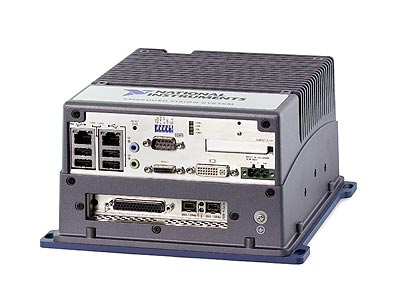
NI Launches EVS-1464RT Embedded Vision System

National Instruments (NI) has released an embedded vision system that gives manufacturing engineers and system integrators the ability to build high-speed real-time machine vision systems. These machine vision systems can be built for applications such as sorting products, verifying assembly and inspecting packaging. The NI EVS-1464RT embedded vision system is a high-performance, multi-core controller capable of processing images from multiple IEEE 1394 and GigE Vision cameras.

Additionally, the EVS-1464RT features an extended temperature range, a real-time operating system, a solid-state hard drive and a fanless design, making it suitable for use in harsh industrial environments. Ivan Meissner, general manager of Qualimatest Technologies, said: 'In our industrial inspection machines, we prefer embedded devices with real-time operating systems because they are dependable and often do not require IT department intervention. 'By standardising on the NI embedded vision system, we are able to achieve the multi-core performance of an industrial PC with the reliability and security of a real-time embedded system,' he added.

The EVS-1464RT features a variety of camera connectivity options so engineers can use many different types of cameras to perform simultaneous inspections, ranging from high-resolution area scan to high-speed line scan and from colour to infrared. It also includes a range of digital input/output (I/O) and industrial communication options that make it possible for the system to communicate and integrate with automation devices such as programmable automation controllers, programmable logic controllers, human machine interfaces, sensors and actuators to perform faster inspections.

The EVS-1464RT can be configured with NI Vision Builder for Automated Inspection (AI): an interactive software environment for building, benchmarking and deploying machine vision applications without programming. With this menu-driven software, engineers can build complex machine vision applications that not only incorporate image-processing algorithms but also advanced decision making with looping and branching using the built-in state diagram editor.

For more advanced applications, the EVS-1464RT can also integrate with the NI Labview graphical system design software and the NI Vision Development Module, which is a comprehensive library of image-processing functions. As both software packages work with all NI vision hardware, engineers can manage and maintain multiple hardware systems, choose the appropriate hardware for new applications and switch between both software options with minimal effort, according to the company.