Phantom v640 provides detailed high-speed images

Vision Research has introduced the Phantom v640 Cinemag camera, for industrial, military and research and development applications that demand ultra high-speed imagery with maximum detail. It offers a recording speed of more than 1400 fps at its full resolution of 2560 x 1600 pixels. For higher frame-rates, users can reduce the camera's resolution, increasing the speed. At a reduced resolution, the Phantom v640 offers a maximum frame rate of 300,000 fps.

This camera can also record at more traditional frame rates for normal use - as low as 10 fps. For example, when recording at 1920 x 1080, users can achieve frame rates of 10 fps, increasing to more than 2700. At maximum resolution of 2500 x 1600, the wide aspect of the Phantom v640's CMOS imaging sensor allows users to keep a moving target in the frame for a longer time than possible with traditional square imaging sensors. The camera's peak quantum efficiency (QE) has been improved to 60 per cent.

The improvement in QE is paired with reduced noise-equivalent power, large pixels and micro-lens technology. Micro-lens technology is designed to increase the efficiency of the Phantom v640's CMOS sensor. It utilises a tiny lens bound to each pixel to direct incoming light more efficiently into the active areas of the photo site. An internal mechanical shutter provides a method of calibrating all of the CMOS sensor's pixels, ensuring accurate images.

To ensure optimal performance while using a digital high-speed camera, a current session reference (CSR) should be completed. The Phantom's internal mechanical shutter allows a CSR to be conducted remotely through a software command, saving time. The Phantom v640's internal mechanical shutter allows the user to simultaneously perform a CSR for all cameras in use. The Phantom v640 features 8Gbit of high-speed dynamic RAM, with the option to upgrade to 16 or 32GB. The internal high-speed dynamic RAM can be divided into up to 64 segments, allowing for the recording of multiple back-to-back shots without having to offload image data to the Cinemag or from the camera.

The Phantom v640 is also ideal for particle image velocity applications. The camera features a timing resolution of better than 20 nanoseconds, one microsecond straddle time, as well as a frame-synchronisation signal available via a dedicated BNC for easier cabling and increased signal integrity. The Phantom v640 is compatible with Vision Research's Cinemag system, a small and light non-volatile, hot-swappable memory cartridge with up to 512GB of memory. Cinemag mounts directly to the body of the camera. It can quickly offload images from RAM and begin the next shot. It also lets the user record full-resolution video at a maximum frame rate of 250 fps directly to the magazine, enabling long recording sequences.

The Phantom v640 includes a component video-out port for use with a viewfinder, allowing recordings to be viewed immediately. Users can access four different configurations: two identical 4:2:2 outputs; independent 4:2:2 outputs where one is live and one is playback; one dual HD-SDI 4:4:4 output; or 4:4:4 playback on the dual HD-SDI while the user has a live image on the component viewfinder. Also available with the Phantom v640 and Cinemag is the Cinestaiton, which accepts a Cinemag and allows download to computer via 10GigE Ethernet, or connection to recorder via dual HD-SDI.

Schmitt Expands AEM Sensor Range

Schmitt has added the Fluid Acoustic Emission sensor to its range of acoustical emission monitoring (AEM) sensors, which monitor grinding-wheel processes. The Fluid AE sensor is ideal for situations where direct acoustic contact is required during the grinding process, for example where machine design, high-frequency bearing, mechanical or electromagnetic-noise prevent the use of other types of AE sensor.

The Fluid AE sensor uses the existing oil or water-based grinding-machine coolant with a separate feed from the cutting stream directed at the component or dresser. The noise of the grinding wheel touching the component or diamond is then transmitted back up the coolant stream to the AE sensor and detected by the Schmitt electronics within one millisecond. User benefits include elimination of the grinding-gap time in the grind cycle, notification and prevention of machine-crash conditions, automatic quality monitoring of wheel dressing and machine positional control.

The AEMS system allows rapid and automatic grinding-wheel in-feed, right up to the point of initial contact with a new part loaded in the machine. The system can automatically detect the initial contact and quickly report this event to the machine control, stopping the wheel in-feed without operator intervention. This system has achieved typical cycle-time savings of up to 20 per cent. The AEMS system can standalone or be added to any SBS grinding-wheel balancer controller, providing two sensor-input sockets.

A four-channel SBS controller can give up to eight inputs from eight different AE sensors. Data can be downloaded via a 0 - 10V analogue output to a PC or external data-logger for QA purposes. Schmitt's acoustic sensors are easy to retro fit, resistant to grinding-machine coolants and grinding paste and give reaction speeds faster than traditional methods of spindle load or current monitoring.

Energy Chain Prevents Loops And Strained Cables

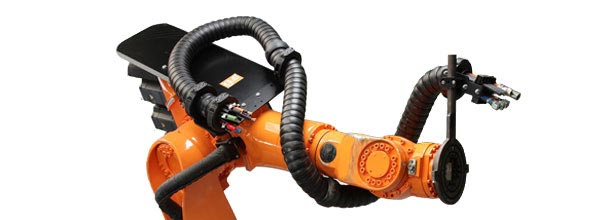
Igus is showcasing several new developments in power and data supply for robotic equipment at Automatica in Munich. The company has developed a universal module called Triflex RS, specifically for robotic applications in cramped conditions. The multi-axis robotic energy chain Triflex RS is guided parallel and close to the robot arm, preventing a loop forming or cables becoming strained at the robot head. The low-profile module can be mounted directly to the existing fastening points on the robot.

The moving end of the energy chain is attached to the sixth axis with a mounting bracket. This system allows general movements, meaning no specific programming is required. Thanks to its compact design, the system can even be used if there is a valve cluster or distributor box on the third axis. Special protective jackets are now also available. They protect the energy chain from liquid-metal splashes or other materials.

These are important in hot conditions such as in foundries, or for paint or sealing applications. The protective jackets are pulled over the energy chain and held by a Velcro fastener or elastic, ensuring the chain's long service life. Igus has developed the E4.1 energy chain for safe energy-supply on the seventh axis. It allows high flexibility and robustness in all applications. Assembly times can be reduced by up to 80 per cent thanks to improved opening and separating bridges.

A quick-locking feature ensures little force is needed for opening and closing, even for fully loaded chains. Special design, including the tongue and groove link joint, improves the self-supporting length by more than 20 per cent. The tongue and groove joint ensures high rigidity even with strong lateral forces.

Laser Lines Marks Code On Tiny Area Of Oil Seal

Laser Lines has recently marked a 10-character code on the outer ring of a customer's oil seal. At the 10.6 micron CO2 wavelength, rubber materials mark very well, but the unusual aspect of this mark was the size of the mark area on the outer ring: it measured only 1.25mm (0.049in) high. The marking set-up consisted of a Synrad laser, FH Flyer marking head and the Synrad Winmark Pro laser-marking software.

The FH Flyer head was equipped with an 80mm focusing lens that provides a 116-micron spot with a 0.8mm depth of field. To create legible text marks, the rule of thumb is that character height should be a minimum of seven-to-ten times the focused spot size. For this application, the character code was 1mm high, which is on the low-end of the range for an 80mm lens. To create this mark, the 'Simple' stroke font was selected, a text height of 1mm was set, 0.15mm of extra character spacing was added, and a text radius of 54mm was entered to match the curvature of the seal.

On the marking tab, power was set with a duty-cycle percentage equal to 10W; a velocity of 1016 millimetres per second was added, and the mark-passes property was set to four. By making four complete passes, the rubber surface is vaporised slowly in small increments, resulting in a cleaner, more distinct mark. The characters are well-formed; the engraved 1mm-high text can be easily read without magnifying aids. This small 10-character code, with four mark passes, was created in a cycle time of only 0.13 seconds per part.

Newport Introduces The Unison Amplifier

Newport Spectra-Physics has brought out the first ultrafast amplifier system with optimised dual-outputs for simultaneous high-energy and time-resolved experiments. The Unison amplifier delivers femtosecond pulses at both terawatt-class intensities at 10Hz frequency and mJ energies in the kHz frequency regime. Newport's Unison amplifier-system features excellent pulse-energy stability and TEM00 spatial mode for high-quality experimental results.

Its modular design provides a versatile system that can be configured for user-specific requirements. Existing Newport Spitfire ultrafast amplifier systems can also be upgraded to Unison amplifier systems. Herman Chui, senior director of product marketing for Newport Spectra-Physics, said: 'The unprecedented breadth of capabilities enables applications ranging from high-energy VUV spectroscopy, higher order harmonic generation and multi-photon and above-threshold ionisation to standard time-resolved spectroscopy experiments such as pump-probe, coherent anti-Stokes Raman spectroscopy (CARS), and THz generation.' The Unison ultrafast amplifier system will be on display at Laser World of Photonics, 15-18 June 2009 in Munich, Germany.

Explosion-Proof Sensors Added To Leuze Range

Leuze Electronic has extended its range of explosion-proof optical sensors with several new versions, and added a range of new protection housings. The housings can be fitted to Leuze Electronic's standard sensors to enable their installation in potentially explosive atmospheres.

The PH 3B55 Ex-n protective housings are designed for use with almost 200 Leuze sensors. This provides optical detection, contrast scanning, and distance measurement from its 3B, 25B and 55 series ranges. Sensors correctly mounted in the protective housing can be used in areas with a potentially explosive atmosphere consisting of a gas/air or dust/air mixture, which is expected to occur seldom and only briefly.

These are Zone 2 (gas) and Zone 22 (dust) of Group II, category 3 according to the CENELEC classification. In Zone 22, the devices can be used with conductive and non-conductive dust. The sensors also comply with the new international standards IEC EN 60079-15 and IEC EN 61241-1.

Absopulse Expands RWY Series Of DC/DC Converters

The RWY 30 is a recent addition to Absopulse Electronics's RWY Series of DC/DC converters for low-power railway applications. This 30W unit is housed in an ultra-compact, lightweight, 57mm x 56mm x 147mm chassis. Full encapsulation in a thermally conductive MIL-specification silicon rubber compound ensures immunity to shock, vibration and moisture, according to the company.

The RWY 30 operates at full specification over a -40C to +70C cold-plate temperature range when installed on a heat-sinking surface. This rugged, low-power converter delivers single outputs or 12VDC or 24VDC and accepts single DC-input voltages of 24VDC, 36VDC, 48VDC, 72VDC, 96VDC or 110VDC with wide input ranges. Other input and output voltages are available on request.

The unit features full electronic protection and up to 90 per cent efficiency, depending on the input/output configuration. The RWY 30 meets the stringent requirements of EN 50155 for electronic equipment used on railway rolling stock. It also meets EN 55022 Class B EMI conducted and radiated with wide margins and is designed to meet IEC 61373 Categories 1 A and B and Category 2 shock and vibration standards.