Showing posts with label Energy. Show all posts

Trinergy Could Cut Energy Wasted By UPS Users

Chloride has announced that its Trinergy UPS technology could significantly cut the energy wasted by the UK's biggest users of electricity and uninterruptible power supplies (UPS). It will also help them avoid additional costs resulting from the CRC Energy Efficiency scheme, which is due to come into force in April 2010, according to the company. Rob Tanzer, Chloride's technical support manager, said: 'The third generation of UPS equipment, such as Trinergy, is now 98 per cent efficient, which, compared to a typical 1,000kW legacy UPS system, can cut the electricity costs of running a UPS by three quarters.

'By cutting UPS energy losses to just two per cent, the system cooling energy requirement will also be reduced, resulting in an overall annual saving of nearly GBP100,000 for every 1,000kW of protected power - and an ongoing carbon reduction equivalent to removing 170 family cars from the road each year,' he added. The CRC Energy Efficiency Scheme (formerly known as the Carbon Reduction Commitment) will initially affect around 20,000 organisations in the UK and the largest 5,000 of these will participate in a Carbon Reduction Commitment League Table that will show the relative performance of CRC participants.

Each qualifying organisation will be required to purchase allowances, priced at GBP12 for every tonne of carbon linked to their energy use. The scheme will operate as a 'cap-and-trade' mechanism, providing a financial incentive to reduce energy use by putting a price on carbon emissions from energy consumption. Organisations will be required to participate in the CRC scheme if they have at least one half-hourly electricity meter (HHM) settled on the half-hourly market.

They also qualify if their total half-hourly electricity consumption exceeded 6,000MWh during 2008. This means many data centres, supermarkets, hotel chains, banks, local authorities and central government departments are affected and will have to purchase allowances to cover their annual CO2 emissions. Qualifying organisations must comply with the scheme or face financial and other penalties.

Tanzer continued: 'Big electricity users needing uninterrupted power typically waste around eight per cent of their entire critical power throughput by putting it through the UPS systems that protect sensitive equipment and processes from power-supply failures. 'Power wastage can be massively cut if older UPS systems are replaced, not forgetting the associated reduction in cooling cost savings, energy cost savings, tax offset, infrastructure savings and more power.

'Comparing the new 1,000kW Trinergy UPS unit against the existing, transformer-based technology of 10 years ago, the CO2 saving could equate to as much as 600 tonnes per year. 'If the CRC allowance is GBP12 per tonne, it would mean that firms would have the potential of saving a further GBP7,200 per year over and above the annual energy savings resulting from operating an ultra-high-efficiency UPS such as the Trinergy system,' he said.

Energy Micro To Develop Low-Power RF Transceivers

Energy Micro is to begin developing a companion range of low-power radio-frequency (RF) transceiver products. The company intends to produce RF devices consuming a quarter of the energy of existing products.

A complete range of RF products is planned for 2011, covering multiple frequency bands and supporting both standard and proprietary wireless protocols. Initial market sector targets will include energy metering, home and building automation and alarm and security industries.

Test Set Gets Bluetooth Low-Energy Testing Option

Anritsu has introduced a Bluetooth low-energy testing option that allows designers and manufacturers of Bluetooth products to conduct radio layer testing in compliance with Core Specification 4.0. With this option, engineers can use the MT8852B to complete a test script covering Bluetooth basic rate, enhanced data rate and low-energy measurements in <15 seconds by pressing a single key. The Bluetooth low-energy measurement option adds six low-energy test cases to the base MT8852B test set.

These test cases can be run as part of a test script to simplify creation of test programs and reduce test times. Bluetooth low-energy measurements are performed directly on the MT8852B, which controls the DUT using defined HCI or two-wire control commands. For development applications, the MT8852B low-energy measurement option is supplied with a PC application that displays low-energy reference test packets in graphical format, as well as providing clear pass/fail status for all supported measurements against the specified limits.

This facilitates the identification of the causes of any device failure during the critical design and development stages. Bluetooth low energy is ideal for applications that require occasional data transfer from devices that run for over a year from a single-button cell battery. Typical applications include sports and fitness devices such as heart-rate monitors, as well as medical products such as blood glucose meters and industrial sensors.

Econa ARM-Based Processors Are Energy Efficient

Cavium's energy efficient Econa CNS3XXX ARM-based SoC processors are now available from Ismosys. The single- and dual-core ARM SoC processors are said to enable high performance, while reducing power and cost for next-generation gateways, storage and consumer electronics devices. The integrated Econa CNS3XXX processors are said to feature a rich set of integrated hardware accelerators and a range of I/Os for glueless voice, video and data connectivity.

Power-management techniques enable the devices to deliver low-power operation starting at less than 1W. The devices target applications including FTTH broadband gateways, network attached storage appliances, multimedia picture frames, media and print servers, IP cameras and wireless access points. At the heart of the Econa CNS3XXX devices is an integrated power-management unit that enables a total of six different power-saving modes during operation, including: wake-on-LAN support; dynamic control of CPU power-per-core; and automatic shutdown of non-operational logic.

On-chip voltage regulators enhance the effectiveness of this PMU, enabling power consumption figures ranging from less than 1W for the single-core version to less than 2.5W for the highest-end dual-core version. Devices in the Cavium Econa CNS3XXX family are built around high-performance ARM11 MPcore processors and caches including Superscalar, ARM11 MPcore processors operating at up to 700MHz, each with 32KB I-cache, 32KB D-cache and a large 256KB L2 cache to provide more than 1,400 Dhrystone MIPS (DMIPS). Each ARM11 MPcore processor comes with instruction set extensions for digital signal processing (DSP) and media processing, and integrates a vector floating point unit (VFP) and memory management unit (MMU).

The cores also incorporate ARM's Jazelle technology, which enhances the performance of Java applets running on the CNS3XXX family. The high-performance cores combined with large caches deliver non-blocking, wire-speed performance for voice, video and data applications. DSP extensions on the ARM11 MPcore processors drive enhanced voice applications including support for wideband codecs, DECT and advanced call-control features such as conferencing.

Additional features of the SoC processors include: advanced acceleration engines, which include a packet switch for wire-speed switching; hardware-based NAT and QoS engine; TCP offload; packet processing engine (PPE) for wire-speed packet processing; content inspection engine for L7 application processing and filtering, Raid 5/6 XOR engine, 2D graphics engine with an integrated LCD controller, and a security engine for high-performance IPSec, SSL, intrusion prevention and anti-virus processing. The devices also support acceleration for the popular standards-compliant video codecs.

High-bandwidth, low-latency integrated memory, system and networking interfaces provided by the Econa CNS3XXX family include: intelligent x16/x32-bit, 800MHz DDR2 memory controller; three Ethernet MAC interfaces supporting RGMII/GMII/MII, Dual USB2.0/SATA2/PCIe - all with integrated PHYs; TDM/PCM LCD interface; SDIO camera interface and system interfaces including GPIO, SPI, UART, I2S and I2C. The Econa CNS3XXX software development kit (SDK) builds upon Cavium's existing Octeon and Octeon Plus SDK and includes: Linux SMP; GNU Toolchain; Simple Executive for fast path applications; performance tools; simulator; feature rich APIs for hardware acceleration; and reference applications.

Chip Is Compliant With Bluetooth Low-Energy Spec

Broadcom has announced that its latest-generation Bluetooth combination chip is compliant with the ratified Bluetooth low-energy version of the Bluetooth technology specification. The Bluetooth low-energy specification enables an ultra-low-power implementation of Bluetooth technology, making the technology increasingly applicable for wireless medical and fitness monitoring devices that necessitate long battery life.

With Broadcom's dual-mode implementation, OEMs can extend these new Bluetooth low-energy applications to smartphones and other devices while also enabling an array of existing Bluetooth functions with a single chip.

Aoki Blow-Moulding Machine Is Energy Efficient

Meredith-Springfield has equipped its facility with two moulding machines and more space to deliver environmentally safe blow-moulded plastic products. Blow-moulding is the plastic conversion process used to make bottles, containers and other hollow articles from plastic resin pellets. Step by step, more plastic bottles that contain liquids, food and health and beauty substances are being made with PET resin.

PET is polyethylene terephthalate and may exist both as an amorphous (transparent) and as a semi-crystalline material. A thermoplastic polymer resin of the polyester family, it is used in beverage, food and other liquid containers, thermoforming applications and engineering resins often in combination with glass fibre. In other words, it is the type of improved barrier technology plastic or non-leaching plastic that will not allow for carcinogenic or other contamination of liquids that are contained within.

PET is what the plastic industry calls 'green' or 'soda bottle plastic' because it is widely recyclable by consumers. The machines chosen are referred to as 'one-step' injection-stretch blow-moulding machines manufactured in Nagano, Japan, by Aoki Technical Laboratories. This equipment is energy efficient and, because of Aoki's Direct Heatcon technology, technical bottles can generally be produced at a lower cost and higher quality than those made with other blow-moulding processes.

Infineon Adds LED Drivers To Energy-Saving Range

Infineon Technologies AG is extending its portfolio of energy-efficient lighting ICs with a range of low-cost linear LED drivers. The BCR320 and BCR420 product ranges address the market for energy-saving and environmentally friendly light-emitting diode (LED) lighting solutions. Designed for driving 0.5W LEDs with a typical current of 150 to 200mA, these LED drivers feature a negative thermal coefficient, contributing to a long lifetime of LEDs and a digital interface for a pulse-width modulation (PWM) signal for dimming.

The BCR320 and BCR420 LED drivers are tailored to address deficiencies for 0.5W LED applications, providing a low-cost solution with a small form factor. With both devices, the use of inductors, capacitors and free-wheeling diode can be avoided. The elimination of electrolytic capacitors can also contribute to the extended lifetime of the LED system. The BCR320 products are designed for a peak output current of up to 300mA. For continuous operation, a maximum nominal current of 250mA is recommended.

While this device has an internal breakdown voltage of typically 20V, it can be operated at supply voltages of 24V or higher, since the driver is operated in series with the LEDs. The BCR320 is targeted at general lighting, architectural and mood-lighting applications. BCR320 devices have a negative thermal coefficient, which means that in case of temperature increase the current is lowered with a slope of 0.2 per cent/K. The BCR320U and BCR321U versions are available in a SC-74 package (2.9 x 2.5 x 1.1mm) with 1W power dissipation. The BCR320P and BCR321P types will be offered in a SOT-223 package (6.5 x 7.0 x 1.6mm), providing a higher power dissipation of 2W.

These versions both offer a logic-level input for dimming. The BCR420 products have a higher internal breakdown voltage and a lower output current than the BCR320 devices. The internal breakdown voltage is typically 50V and the nominal output current is 150mA. The BCR420 LED drivers are intended for use in similar applications for a maximum drive current of 150mA. Qualification for use in automotive applications, based on AECQ 101 certification, is ongoing. BCR420 and BCR421 products are available in SC-74 package - BCR421 is the dimmable version with a microcontroller interface.

ABB Drives Reduce Swimming Pool Energy Bills

ABB drives have helped a UK holiday park operator save GBP77,000 a year on energy bills for its swimming pools. Bourne Leisure, which owns brands such as Haven, Butlins and Warner Leisure hotels, has swimming pools at a number of its properties. ABB Drives Alliance partner APDS was asked to investigate the energy-saving potential for the swimming pools and a trial was conducted on two of the three filtration pumps at Bourne Leisure's Devon Cliffs site.

The pump was monitored for a period before a variable speed drive (VSD) was installed. Monitoring with a temporary VSD fitted demonstrated that considerable energy savings could be made. The direct-on-line pumps were working at 50Hz drawing an average of 30A. When the drive was introduced, this figure was reduced to 23A during the day and 15A at night, with no effect on water quality. APDS and ABB recommended fitting VSDs to the pumps feeding the pool filters.

The pump filters operate by trapping dirt and debris in the sand filter and returning clean water back to the swimming pool. Pumping the water at a reduced flow rate improves the filtration process and removes more contaminants. The traditional method achieved this by increasing the diameter of the feed pipes and introducing a control valve to limit the flow. This was obviously wasteful as the pump was still running at maximum speed.

Doug Pitt of APDS said: 'The trial showed the predicted savings for each 18.5kW pump at Devon Cliffs was GBP4,899 per annum, giving a payback period of less than six months. 'The actual savings exceeded those predicted in the energy report as the motor speed could be accurately mapped to pool utilisation,' he added. ABB drives ranging from 3.3kW to 30kW were eventually installed in 36 Bourne Leisure owned pools around the country, including two Butlins parks, making savings of up to GBP11,000 depending on size of pool and number of drives. In total, the company is saving nearly GBP77,000 per annum on running its pools, with a total payback time for the entire project of just over a year.

'The conversion only takes a day, with most of the rewiring done at night, so there has been very little disruption for our guests,' said Craig Valentine, health and safety manager for Bourne Leisure. Other features of the ABB drives include the real-time clock that allows the pumps to be started and stopped according to a schedule of use. The drives also have a boost button that can immediately take the pumps up to full speed for the backwash cycle.

Reduced bearing wear of the pumps has also been another benefit of the drives, due to extended ramp times. ABB is working with a specialist pool company on phase two of the project, which will see the drives receiving signals from a dosing machine. This will ensure the drives run at a speed more accurately matched to how the pool is used to ensure the correct dosing of additives such as bromine to maintain the optimum conditions in the pool.

HRP-75 Power Supply Is Energy Star Compliant

Mean Well has introduced the HRP-75 series, a 75W miniature high-reliability AC/DC enclosed power supply that is now available from Ecopac Power. The HRP-75 series, along with the existing range of products HRPG-150, HRPG-300 and HRPG-600, allows Mean Well to offer various wattage options from 75W to 600W all with PFC function and energy-saving functions.

Featuring low no-load power consumption and an operating efficiency of 89 per cent, the Mean Well HRP-75 series reduces the size and increases the working efficiency in comparison to the existing range of 75W power supplies. With a five-year warranty, the HRP-75 series complies with Energy Star and operates at -30C to +70C. In addition, as the units comply with the 'no load power consumption of less than 0.5W', it allows designers to conform with the requirements of Energy Star and EuP for end-user systems and applications.

The HRP-75 series has a profile of less than 1U (41mm) with overall dimensions of 129mm x 98mm x 38mm. With a universal input of 85-264V AC and built-in active PFC function, the units are designed to withstand 300V AC surge for five seconds and include short-circuit, overload, over-voltage and over-temperature protections. The Mean Well SPV series is supplied with worldwide safety certificates, UL, CUL, TUV, CE and CB.

DS Refrigerant Dryers Reduce Energy Consumption

Boge has brought out a range of energy-saving refrigerant dryers. The DS series features components used in compressed-air drying. Optimally dimensioned components assure reliability and efficiency, even in the most demanding conditions. The DS series dryers also constantly adapt to changes in ambient and volume flow to ensure dry compressed air is always delivered.

At the same time the intelligent heat-exchanger system creates a lower pressure drop when compared with conventional systems. This low-pressure drop means that the compressor generation pressure can be reduced, with each 1 bar pressure reduction translating into a six per cent energy saving. By ensuring the lowest possible pressure loss, a high level of energy efficiency can be achieved.

As the energy consumption of the compressor is greater than the dryer, these savings have a much larger impact and so increase the efficiency of the compressor. It is estimated that over a five-year operating period the purchase price of a compressed-air dryer accounts for only about a third of the total cost. A third of all costs are spent on the electricity required to run the dryer for five years. A further third is consumed over a five-year period by the compressor in order to overcome the dryer's pressure drop.

With the Boge DS series, lowest possible pressure losses reduce energy consumption year on year, impacting on the associated electricity used year on year. The DS dryer control continuously adapts the dryer operation to the real operating conditions.

This ensures continual energy saving. The new DS series dryers are compact and have been designed for ease of maintenance. The DS series has a standard 3C pressure dew point and a flow capacity from 7.5 to 180m3/min. The range is environmentally friendly, emits zero ODP and low GWP and is Montreal Protocol compliant.

Energy Chain Prevents Loops And Strained Cables

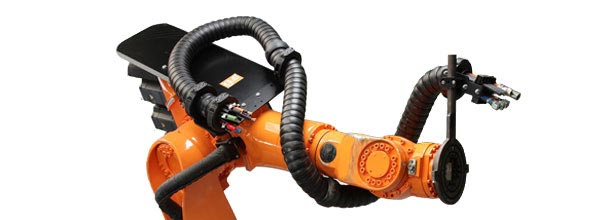
Igus is showcasing several new developments in power and data supply for robotic equipment at Automatica in Munich. The company has developed a universal module called Triflex RS, specifically for robotic applications in cramped conditions. The multi-axis robotic energy chain Triflex RS is guided parallel and close to the robot arm, preventing a loop forming or cables becoming strained at the robot head. The low-profile module can be mounted directly to the existing fastening points on the robot.

The moving end of the energy chain is attached to the sixth axis with a mounting bracket. This system allows general movements, meaning no specific programming is required. Thanks to its compact design, the system can even be used if there is a valve cluster or distributor box on the third axis. Special protective jackets are now also available. They protect the energy chain from liquid-metal splashes or other materials.

These are important in hot conditions such as in foundries, or for paint or sealing applications. The protective jackets are pulled over the energy chain and held by a Velcro fastener or elastic, ensuring the chain's long service life. Igus has developed the E4.1 energy chain for safe energy-supply on the seventh axis. It allows high flexibility and robustness in all applications. Assembly times can be reduced by up to 80 per cent thanks to improved opening and separating bridges.

A quick-locking feature ensures little force is needed for opening and closing, even for fully loaded chains. Special design, including the tongue and groove link joint, improves the self-supporting length by more than 20 per cent. The tongue and groove joint ensures high rigidity even with strong lateral forces.

SEMS Uses Braking Energy For Vehicle Systems

Parker's latest stored energy management system (SEMS) has been developed especially for use with vehicles such as refuse trucks and short-haul delivery lorries, that frequently stop and start. SEMS uses Parker hydraulic and electronic technology to capture the kinetic energy converted by vehicle braking systems, with the energy then being made available to power on-board equipment.

This considerably reduces demand on the engine, which in a typical application in a refuse vehicle can translate into fuel savings of up to 5 per cent, with a corresponding decrease in emissions. In addition, the use of stored energy from the accumulator eliminates the need to run the engine at high speeds while the vehicle is stationary in order to drive systems such as the compacting and crushing units found on refuse vehicles.

As a result, operating noise can be significantly reduced, by as much as 50 per cent depending on the application; this is of considerable benefit for vehicles that have to be used in built-up residential areas, allowing them to be used at quieter times of day or night when there is less traffic congestion. SEMS incorporates a conventional Parker hydraulic accumulator, which is automatically charged every time the vehicle brakes; alternatively, the accumulator can be powered by an electronically controlled pump attached to a power take-off (PTO) point.

The accumulator is normally linked to a hydraulic converter that reduces the stored high-pressure energy to the exact level required by the different items of ancillary equipment on each vehicle. Overall system management is then achieved by Parker's IQAN software-based hydraulic control technology, which combines in-cab HMI units and joysticks with specialised sensors, I/O and interfaces, to create a powerful yet flexible method of monitoring and controlling hydraulic systems.

SEMS is supported by Parker's worldwide network of manufacturing and customer support centres, with the company working in partnership with vehicle OEMs to develop hydraulic systems that add to vehicle performance, efficiency and productivity.

New A Proctor Group Energy Visitor Centre

As innovators of intelligent building products, A.Proctor Group have opened the Visitor Centre to offer practical advice and showcase the latest solutions for energy efficient homes and buildings. The Visitor Centre, at Dunkeld Road, Blairgowrie was officially opened by Mr John Swinney, MSP.

It is open to specifiers, contractors and the local community, with the option to book one-to one consultation appointments with Technical personnel. The Centre will be open Monday to Friday 9.00am - 5.00pm and Saturday mornings 9.00am - 1.00pm. A Technical Advice Team will be available to advise on products, view drawings or provide thermal and SAP calculations, whilst visitors can walk through the exhibition area and have a practical demonstration using display models.

The opening will take place between 12.00 noon and 2pm, on Monday 6th April, with speeches from John Swinney, MSP and Allan Proctor, Managing Director, followed by a buffet lunch. If you are interested in attending the opening of the Visitor Centre, or wish to make an appointment, please contact Sharon Lamond on 01250 872261.

ABB Drives Reduce Energy Used By Fridges

ABB Group's Variable Speed Drives have won an award for cutting energy usage and extending the life of refrigerators. The Food and Drink Innovation Network Clegg Food Projects Award for New Process and Environmental Awareness was presented to ABB at a gala dinner at the National Space Centre, Leicester. More than 60 per cent of industrial electrical energy is used to power electric motors, the majority of which are used on fans, pumps and compressors.

These devices are used in refrigeration equipment. The motors driving these applications usually run at a constant speed, even though the load is varying. Using variable speed drives (VSDs), the speed of the motor can be slowed down, thereby reducing the amount of energy consumed. A VSD can be retrofitted to most existing systems.

The mechanical controls are simply locked fully open and the VSD directly controls the speed of the electric motor. Since cold storages and fridge plants typically run for 24 hours, most refrigeration drive applications are potential VSD candidates. Any refrigeration system with a wide variation in operating hours or with a heat load that is less than the peak load can benefit from a VSD. ABB applied existing technology to the food industry by developing bolt on variable speed drive motors for refrigerators.

These keep units running at regular speeds and prevent peaks of energy use when something is put inside a fridge, reducing energy use and costs and cutting carbon footprints. This increases the life of the equipment. Instead of continually running at full speed, the lower speed reduces stresses, increases the equipment life and extends service intervals, cutting maintenance costs.

Saft To Showcase Energy Solutions

Saft are to exhibit a range of energy solutions developed to meet the dynamic needs of the telecommunications industry. Saft's main focus for the exhibition is on power backup systems that ensure maximum reliability and optimum total cost of ownership for the wide variety of remote or outdoor plants now playing a vital role in decentralised telecom networks. Key technologies on show will include the Tel.X maintenance-free nickel-cadmium (Ni-Cd) battery together with the Intensium range of lithium-ion (Li-ion) battery systems.

Saft has developed Tel.X to offer advantages for demanding outdoor telecom applications in remote areas. It is compact, light and takes around 15 minutes to install a 48V battery. Tel.X offers a service life of more than 20 years in normal temperatures and more than 14 years at 40C. In many cases the battery can be expected to outlive the installation, meaning it will not need topping up with water. Tel.X offers volumic energy density of up to 100Wh/L. It is designed for use in standard 19in and 23in racks and cabinets. Tel.X offers performance over a temperature range of -20C to 40C and can withstand extremes from -50C to 70C.

Unlike valve regulated lead acid batteries often found in telecoms applications, the construction and engineered electrolyte used in Ni-Cd batteries mean they cannot not suffer from 'sudden death'. Tel.X is suited for backup power applications in outdoor installations, such as cabinets and end terminals in fibre-optic triple-play networks, as well as BTS (Base Transceiver Station) and BSC (Base Station Controller) installations in wireless networks. Intensium Li-ion batteries provide power and energy density in a compact, rack-mounted modular system.

The latest addition to the range is the second generation Intensium 1 Power Plus battery intended for short duration power backup, from 3 to 30 minutes. It is suited to smaller, decentralised outdoor plant installations, required to support telecoms networks such as micro and macro BTS. This Li-ion offers an anticipated 20-year life at 20C and a 10-year life at 40C. The new batteries offer 30 per cent more power, with the maximum power increased from 3kW to 4kW. As well as the standard 48V battery system, Intensium 1 Power Plus is now available in a 24V version.

Energy Services Contract Covers 170,000 Homes

Eltel Networks has been awarded a contract by the Danish utility EnergiMidt to deploy Echelon's Networked Energy Services (NES) system to all of its 170,000 residential customers. Gorlitz is providing its EDW3000 software, a meter data management system (MDMS) and integration platform which runs on top of the NES system software to provide a rich set of utility applications.

Revenue to Echelon for the project, including meters, data concentrators and software, is expected to total approximately US $18 million. Volume shipments should begin in the fourth quarter of 2008 and to continue into 2010. The NES advanced metering infrastructure from Echelon consists of a family of highly integrated, advanced electronic electricity meters accessed via a web services based network operating system over an IP networking infrastructure.

Unlike systems with a dedicated radio per metering point, multiple NES meters can share a single IP connection through the use of Echelon's proven standards-based power line networking technology. This drives down the per-point connection cost and enables the system to easily and cost-effectively incorporate new wide area networking technologies over the life of the system.