Korber Schleifring is offering the DMG Microset tool presetting products to UK customers as a result of a European marketing collaboration between Walter Maschinenbau and DMG Microset. In return, DMG will be able to supply Walter tool grinders and tool inspection machines.
Designed to optimise set-up cycles/times, Microset tool presetters cover a range of tool sizes for a host of turning machines. The collaboration will include the mutual supply of hardware and software components.
Showing posts with label Tool. Show all posts
Showing posts with label Tool. Show all posts
Magnetfinish Range Improves Tool Lifetime
 The Magnetfinish range of machines has been designed to finish all types of cutting tools, improving tool lifetime and performance under heavy cutting conditions. The Magnetfinish technology has been developed to increase tool lifetime. The process polishes the flutes on all types of HSS and Carbide rotary tools such as endmills, form cutters and drills, provides conditioning or edge honing of the cutting edges (micron rounding of the edge) and is also used to polish profiles on taps and coated cutters.
This is said to result in a superior chip flow, leading to the increased productivity of the tool. The surface finishes on the tool flutes that are generated by the Magnetfinish process are of the order of 0.02um Ra. These fine finishes are said reduce the subsequent friction caused by chips running through the cutting tool flutes by 50 per cent. This results in faster and smoother chip evacuation that allows faster feeds to be used, speeding up cycle times during milling and drilling operations. The tools' primary cutting edges are machined to allow a defined and reproducible radius of between 3 and 50um to be created.
This edge-preparation process can increase the lifetime of tools such as ball-nosed end mills by a factor of four and allows more consistent machining results to be achieved. The Magnetfinish process is based around two rotating magnetic heads, between which a layer of processing powder is placed. The powder is made up of magnetic and abrasive compounds. The magnetic compound is used to hold the abrasive compound within the magnetic field that is generated by the rotating magnetic heads and then the abrasive compound itself performs the cutting function to the surface of the cutting tool.
The thickness of the processing powder is between 5-7mm and this allows 50 layers of powder grains to contact the surface to generate the fine surface finishes and radius edge forms that are required onto the cutting tool. Because the powder is constantly refreshed during the Magnetfinish process, 100 per cent reproducible results are said to be guaranteed across large batches of tools. A typical deep hole carbide drill of 6 x 180mm in length can be machined in 20sec, with the average machining time for smaller tools being in the region of 5-10sec.
Magnetfinished milling cutters are especially effective when used for hard milling applications, such as those used for producing very fine milled finishes on moulds that then require little or no hand polishing. For the cutting tool to achieve an effective chip load, the associated feed rates and spindle speeds must be much higher than those normally applied in traditional milling. The higher feed rates also make it possible to complete a much larger number of passes across the workpiece more quickly than with traditional methods.
The combination of light cuts at very high feed rates makes it possible to remove steel in the hardened state with small-diameter, fine-radiused tools said to generate surfaces that approach the quality of those that are often finished polished by hand.
A variety of Magnetfinish machines are available from small and cost-effective manually loaded machines for low-batch production through to large, automated cells with a capacity to automatically load cutting tools for processing from 240 station magazines. The entry-level manually loaded MF61 machine has a general capacity for cutting tools from 0.1 to 20mm in diameter and for tool lengths of up to 300mm. It is equipped with a simple laser-based safety curtain to allow for parts to be manually exchanged at ease without the need to constantly open and close a door. Tools are manually loaded and unloaded to a centrally positioned pneumatic gripper unit that will accept cutters of various diameters and lengths.
This machine in the automated MF61A version can be specified with an optional 45-position automatic part loader. Both machine versions are operated by a touch-panel operator control screen and all tool data can be stored for subsequent recall. It is possible to mix different types and sizes of cutters within the optional auto-loader, with the entire batch of cutting tools then being processed without any operator involvement. Both variants are very compact machines, requiring the minimum of floor space for installation near to adjacent cutter grinding cells.

Pick-And-Place Tool Is Top Activated
 Virtual Industries has introduced the Vacula VC-3 heavy-duty Vacuum-Tweezer, a self-contained pick-and-place tool that is activated from the top. Users depress the plunger and place the rubber suction cup on the package to pick and release the plunger, enabling the part to be firmly grasped by the tool.
The part is then placed on the desired location and the plunger depressed for a second time to release it. This ESD-safe unit eliminates contamination from skin oils and handling damage to leads. It is suitable for loading burn-in trays or tinning leads and easily handles larger packages.
This tool includes the 1/2in (12.7mm) diameter heavy-duty vacuum pen and two handling tips, a 1/2in (12.7mm) and a 5/8in (15.88mm) diameter rubber vacuum cup. Optionally, this tool can be used with VI's multiple cup pick-up tips or any of its cups on a luer slip probe.
Schurter Develops Connector Search Tool
 Using Schurter's Parametric Search for Mating IEC 60320 Connectors tool, customers can quickly find a power supply connection solution for a particular application. Searching for suitable equipment connectors (appliance couplers) means selecting the connector parameters according to IEC 60320.
The search for connector options on the Schurter website, which can be performed from the most diverse perspectives and several points of departure, will yield a manageable selection of products within a very short amount of time, claims the company. The information on the website and on the respective product fact sheets will produce exactly the counterparts required.
Schurter offers a large portfolio of appliance couplers according to IEC 60320 as well as the corresponding power supply and interconnection cords, which, for better clarity, is divided up into several functional groups such as: connectors, distribution units, power entry modules with and without filter, cord connectors or cord sets. The product search within these functional groups can be narrowed down further by selecting the corresponding product characteristics (web selectors).
More than 2,000 possible connector combination/mating options (all based on IEC connector parameters) are now available under parametric search. This allows customers to search for equipment connectors from the most diverse perspectives. Under 'General Information', users are told exactly which standard each component is in compliance with and how the terminology associated with a given product is to be interpreted.
Tentec Refurbishes Bolt-Tensioning Tool
 Tentec has helped the Artemis Ocean Racing team after its bolt-tensioning tool seized just six days before a big race. The tensioning tool failed while refitting the vessel's keel and the technicians needed help fast. After a quick call to Tentec, an engineer was sent to Ocean Racing's HQ within the hour to assess the situation. As suspected, it was the tool cell within the tensioning equipment that had been damaged and required refurbishing back at Tentec's factory.
The bolt tensioner had been specifically designed and manufactured by Tentec. The application uses titanium bolts to hold the long central stabiliser 'fin' of the yacht and needed a special insert within the tool. This fin is fully adjustable via hydraulic rams for various trim settings of the vessel.
The bolts are held within a glass-fibre structure at the base of the mast, which is the critical stress area of the vessel. However, time was of the essence and the demands of the refit meant the team could not be without the tool. Tentec once again came to the rescue as Peter Koller, Tentec's account manager for Artemis Ocean Racing, realised he had an exact replica of the tool cell, as a demonstration model, back at his office.
Next morning he was back at the refit yard and worked with the technicians to ensure this tool could do the job. Within an hour, three out of the 12 nuts were tensioned and Koller left the tool at the yard for the completion of the refit. Within six days the refit had been completed and sea trials were underway around the Solent ahead of Cowes Week, the Artemis Challenge and the Rolex Fastnet Race. During this time, the original bolt-tensioning tool was completely refurbished back at Tentec.
MPS 32 Tool Changer Adds 40mm To Robot Arm
 The MPS 32 from Staubli's connectors division provides efficient and secure tool changes for all types of robot arms, reducing the need for investment in additional robots. Its compact size minimises any loss of daylight and adds 40mm to the robot arm. Increasing the utilisation and productivity of automated manufacturing cells frequently requires several operations to be completed by robots, all within the production cycle time.
The end of arm tools required during the cycle can range from drilling or grinding heads to grippers or gauges. Additional operations usually require additional robots; but with the facility to quickly and automatically change the tools on a robot arm, the need for a second or even third robot is eliminated, reducing the capital investment required, improving payback and often reducing the overall cell footprint. Staubli's range of automatic tool changers are specifically designed for these types of applications and the introduction of the MPS 32 extends their benefits to installations using smaller, lighter-weight tooling in compact cells.
All are directly mountable on the robot flange and provide secure locking and unlocking. Staubli's tool changers now extend from 32kg right up to 630kg tool-weight capability and in many applications have performed successfully for more than one million connection cycles. The MPS 32 is a compact unit, measuring 63mm diameter and 40mm wide, and both robot-side and tool-side elements together weigh only 0.7kg. It can handle payloads up to 32kg, operating within a pressure range of 4.5-10.0 bar.
The locking unit is a double active, pneumatically actuated system that ensures secure retention of the tool; additional internal springs make certain that the tool is securely held by the changer even if the pressure drops. All systems required by the tools are connected automatically, employing the technology used in Staubli multi-coupling plates; fluid lines; signal connections such as required for actuators, sensors, bus systems or fibre optics; and power connections are automatically connected to the tool and disconnected without any loss of fluid or ingress of air into the circuits.
NL Machine Tool Distributes Monza Grinders
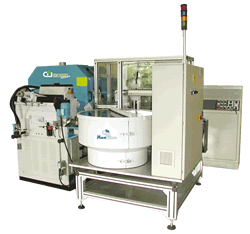 NL Machine Tool Consulting has announced that it is the exclusive UK distributor for Italian manufacturer Officine Monzesi. Officine Monzesi is the manufacturer of Viotto single and double disc grinders, Monvibro vibratory bowl/linear feeding units and bespoke automatic loading/unloading systems and Monza centreless grinding machines. The company is also launching a line of modular CNC centreless grinding machines.
The Monza Line 20 is based upon robustness, reliability and ergonomic layout. The range provides CNC solutions from one to eight axis, in six sizes, with grinding wheel from 300mm OD x 100mm wide, up to 610mm OD x 500mm wide, capable of grinding work pieces with a diameter up to 200mm, allowing high levels of stock removal with high standards of accuracy.
The machine base consists of an oversized one-piece cast-iron multiple-box section structure - heavily ribbed, vibration free and thermodynamically stable. Electronically interlocked safety protection (guarding) provides a high level of operator safety and environmental protection, yet allows easy access to the grinding area for machine set-up or when manual loading is required.
Working carriage modification allows grinding of smaller component diameters even when the driving wheel is completely used. The dressing process, when not controlled by CNC, has been transformed from hydraulic to electric, thus avoiding potential problems related to oil hydraulics. All motors are digital, including the regulating wheel rotation. The grinding wheel motor can be set to continuous constant surface speed.
Fully automatic wheel balancing is available as an option. The Monza Line 20 range of centreless grinding machines equipped with Fanuc CNC control systems and Officine Monzesi software provide CNC programs that are designed to monitor and analyse the grinding cycle and allow the operator to work without using ISO programming.
This flexibility allows the grinding cycle to be changed quickly and the set-up time to be reduced. A wide variety of application-specific loading/unloading systems are available as well as different types of post-process gauging systems, providing feedback information and automatic machine adjustment.
GEOID Software Reduces Tool Costs
 Blohm Jung has announced that at the Schleifring Grinding Symposium 2009, it will present, under the expression GEOID, a new development for compensation of contour faults in dressing tools. The example shows the quick manufacture of a blanking punch on the Vario D. GEOID was developed in conjunction with the Georg Simon Ohm University in Nuremberg.
The software for compensation of uneven wear in dressing tools is a further development of the automatic diamond adjustment by Blohm Jung and is used in conjunction with the CNC PA37K profile dressing device and the table version PA130TM. Topography of the cutting edge of the dressing tool can be determined with accuracy using GEOID. The correction values calculated are fed directly into the dressing program and create a perfect contour on the grinding wheel.
The result is an increased service life for the dressing tool, reduced costs of tools and improved contour accuracy. For profile grinding, different dressing systems are available for the Vario range of profile grinders by Blohm Jung. According to requirements, profiled crushing units, fixed-profile diamonds or swivelling diamond wheels are mounted on the grinding table. The company said a highlight of the range is the CNC PA37K head-dressing unit.
The function 'CD Abrichten' (continuous dressing), or parallel dressing cuts machining times by up to 50 per cent. Blohm Jung will also show how the GEOID correction software determines the actual contour of the diamond via a measuring probe and then corrects the dressing program accordingly. Therefore GEOID compensates for the wear in individual diamonds and diamond wheels, increases the usability of the dressing tools, and reduces the costs of tools.
Stemmer Offers Printqual Image Processing Tool
 Stemmer Imaging has unveiled the Printqual Image Processing Tool for print quality inspection, as part of the Common Vision Blox hardware-independent imaging toolkit. Printqual allows a monochrome or colour test image to be compared quantitatively against a specified reference image for applications in every sector of print inspection.
It is an ActiveX control that can be used to inspect a wide range of print substrates such as paper, cardboard and labels, as well as overprints. Even highly complex work pieces, such as lead frames and printed circuit boards can be inspected for errors. Work with Printqual is divided into a learning or training phase, and the subsequent automatic inspection of the items. Acceptance thresholds can easily be determined by one or more acceptable test images.
The thresholds can be adjusted for the images to be accepted. The test image is position and distortion-corrected, and a comparison is made in terms of small, medium and large-scale structures within the image. All images producing a quality score below the determined acceptance thresholds will be rejected by Printqual. Unlike conventional correlation methods, Printqual makes it possible to distinguish between a large number of small errors and a single large error. The algorithm is so sensitive that errors of only a few pixels in size can be identified.
Subscribe to:
Posts (Atom)