Showing posts with label Control. Show all posts

The Astro Saber AVA & Astro Handheld Control Head (HHCH)

The Astro Saber AVA & Astro Handheld Control Head (HHCH) Tube. Duration : 1.38 Mins.


*****Copied from my old account (mototaku)***** Proof that it actually exists and works: the Astro Saber AVA with a full-display Astro HHCH. Test radio is a VHF model III in a Model II case. Details from Batlabs: -AVA Cradle, part #PLN7736A. Yes, it is intrinsically different than the NTN7727x AVA cradles all over eBay, although how exactly is not known at this time. -XTVA handheld control head, part #PLN7737x. The kit pictured below uses a PLN7737A head which works with the AVA, but not with an XTVA. However, a late-revision PLN7737B head was also tested with the AVA and found to work identically. It plugs into the 8-pin RJ45 mic jack on the side of the cradle using a straight-through (1-1, 2-2, etc.) coiled cable that is identical to the cable used on MCS2000 full-keypad microphones and XTVA handheld control heads. -A very specific range of HOST firmware in the Astro Saber radio used: between AP_R03.20.01 and R05.60.xx. DSP version is irrelevant, as is the VOCON size. Both 512K and 1 MEG radios with firmware in this range were tested and found to work. Conceivably a 512K VOCON with DSP8 firmware forced in through chip programming would work. HOST firmware outside this range will either exhibit erratic or nonexistent function of the HHCH, or cause it to flash FAIL 01/90. -Handheld control head button functions enabled in the Astro Saber's codeplug through LAB programming. Some whoreflash s-recs/codeplugs floating around out there are set up for it, others are not. There ...

Keywords: motorola, astro, saber, radio, amateur, batlabs, wacker

Check Out OEM Samsung Scx-6320r2 Drum Unit for SCX 6120, SCX 6220, SCX 6320f, SCX 6322dn, SCX 6520fn

OEM Samsung Scx-6320r2 Drum Unit for SCX 6120, SCX 6220, SCX 6320f, SCX 6322dn, SCX 6520fn Best


Rate This Product :


OEM Samsung Scx-6320r2 Drum Unit for SCX 6120, SCX 6220, SCX 6320f, SCX 6322dn, SCX 6520fn Feature


  • Supported printers: Samsung SCX-6220, Samsung SCX-6220F, Samsung SCX-6520FN, Samsung SCX-6322DN, Samsung SCX-6320F
  • Individually factory sealed
  • Sold exclusively by OCinkjet
  • Genuine OEM Product
  • One year factory warranty against product defect


OEM Samsung Scx-6320r2 Drum Unit for SCX 6120, SCX 6220, SCX 6320f, SCX 6322dn, SCX 6520fn Overview


Genuine brand new Samsung SCX-6320R2 imaging drum unit compatible with SCX-6220/6320F printers.


Customer Reviews


*** Product Information and Prices Stored: Feb 08, 2012 20:11:57

ISD860 Drives Gives High Servo Performance Control

Based on Technosoft Motionchip DSP technology, ISD860 is a flexible intelligent drive. It has been developed for motion applications that require cost-optimised design, embedded intelligence, networking possibilities and high servo performance control. It is able to drive 12A continuous and 31A peak currents at a supply voltage ranging from 12 to 72V DC, with a PWM of 20 kHz frequency. Embedding motion controller, drive and PLC functionality in one 136 x 84 x 26mm unit, ISD860 controls brushless, DC or linear motors up to 860W continuous/2.2kW peak voltage.

Due to its advanced motion-control algorithms, a precise control of position, speed or torque over a range of dynamic conditions can be achieved. ISD860 works in single-axis, multi-axis or standalone configurations. The drive setup, tuning and motion programming are made simple with Easymotion Studio and Technosoft Motion Language (TML), according to the company. With ISD860, motion programming can be done from a CAN master, via PC/PLC, using the appropriate motion library, or directly at drive level through its built-in motion controller.

The embedded Technosoft Motion Language includes a high-level command protocol, which can be used by the host through the onboard RS232/CAN serial interfaces. A CANopen version of the ISD860 drive, supporting DS-301 and DSP-402 profiles, is also available. In standalone operation, ISD860 can be managed with programmable I/Os or analogue inputs. Using the TML language, multiple operations can be performed with ISD860: setting of various motion modes (profiles, PVT, PT, electronic gearing or camming, etc), change of motion modes and/or parameters, execution of homing sequences or program flow control.

At the same time, IDS860 can handle digital I/O and analogue input signals, execute arithmetic and logic operations, and transfer data between axes. The drive is able to control other axes via motion commands. ISD860 can send commands to a group of axes, or synchronise all the axes from a network. Flexibility and easy implementation make ISD860 suitable for higher-power motion axis-control using modern distributed intelligence architecture. The drive is suitable for cost-sensitive applications, from medical to factory automation, requiring high servo performance and enhanced compactness.

Invensys Enhances Its Enterprise Control System

Invensys Operations Management has released the next evolution of its Infusion enterprise control system (ECS). The Infusion ECS 2.0 features new software platform updates; integration with the company's Foxboro I/A Series distributed control system and SCADA hardware and software offerings; open integration with almost any other automation or information system; and enhanced platform integration with the company's latest advanced applications, including its Wonderware batch manufacturing execution systems, mobile workforce management, enterprise manufacturing intelligence and enterprise business system integration offerings.

With its new capabilities and an integrated offering that can reduce the total cost of ownership, the Infusion ECS 2.0 is intended to help customers consolidate information across their existing automation and information systems, according to Invensys. By enabling real-time access to critical business intelligence, industry users can balance competing strategic objectives related to safety, controls, assets, productivity and the environment to maximise their overall profitability.

'With the Infusion 2.0 solution, it is significantly easier to provide, manage and contextualise information for a wide variety of operations users, allowing them to drive and deliver greater production value in real time,' said Dave Woll, vice-president of consulting services at the ARC Advisory Group. Introduced in 2006, the Infusion ECS utilises open, industry-standards-based Archestra technology that unites process and production control with business operations control.

The system provides functional object templates for a range of control and manufacturing operations applications that work within a single development and management environment. The Infusion ECS can help save time, effort and money by improving the user's ability to view and synchronise information from multiple systems and applications; enhancing collaboration, execution and operations management across a variety of functions within the enterprise; and improving the ability to create and replicate solutions across the enterprise.

Sudipta Bhattacharya, president and chief executive officer of Invensys Operations Management, said: 'Our customers tell us that they need to operate a real-time enterprise so they can react to business variables and balance environmental, productivity and control trade-offs without jeopardising profitability or plant safety. 'Most systems are isolated and only allow optimisation within specific processes or plants. 'The Infusion ECS, however, allows manufacturers to optimise their operations across the entire enterprise,' added Bhattacharya.

Article Describes PAT For Automated Mill Control

An article jointly authored by specialists from Malvern Instruments and a major pharmaceutical company has been released. The article describes the implementation of a Malvern Insitec online particle-size analyser on an active pharmaceutical-ingredient milling operation at a commercial site.

The Insitec was used to transform a standalone manual mill into an automated process unit that will integrate into the manufacturing facility. Automation benefits include improved product quality, increased throughput and less waste, and the authors state that the solution also opens the route to semi-continuous operation and real-time release.

The Insitec laser diffraction particle-size analyser was designed for use in the process environment. The article describes the change from batch milling with particle size measured offline, to the use of real-time, online measurement and control, and the efficiencies and benefits that this has delivered.

The change began with a pilot-plant trial of the Insitec, followed by implementation at the commercial manufacturing site and the successful development of closed-loop control of the mill. With automated control in place the mill responds flexibly to batch to batch variation in the feed, consistently maintaining product quality.

LED Driver Includes Brightness Control Function

Toshiba Electronics Europe has launched a 16-channel light-emitting-diode (LED) driver that combines brightness control with a built-in pulse-width-modulation (PWM) greyscale capability. The TB62721 is suitable for traffic signs, information boards and other large-panel displays requiring the accurate and reliable control of multiple-colour LEDs.

The new driver can deliver output voltages of up to 38V and provide constant currents of between 2mA and 80mA per channel using a single resistor. All of the functionality needed to deliver 256-step output brightness control is integrated into the device, while the onboard PWM capability provides 65,536-step greyscale control per channel. Both the output-to-output accuracy and IC-to-IC accuracy of the TB62721 are 1.5 per cent.

This allows large displays based on multiple LED chains and drivers to maintain consistent brightness levels within very tight tolerances. Designed for secure, reliable operation, the TB62721 features onboard protection, including thermal-shutdown, output-open and short-circuit protection, and a power-on-reset function.

The TB62721 is supplied in an SSOP24 package and can operate with input voltages ranging from 3.3V to 5.0V. Interfaces are fully BiCMOS compatible and the device can handle serial input data rates to 30MHz.

Pocketlube Provides Total Control Over Lubrication

C-Cubed has added the Pocketlube to its range of condition-monitoring tools, giving the user total control over lubrication. C-Cubed's range of predictive-maintenance tools is based around an ultra rugged and waterproof handheld unit with a high-quality colour touch-screen display.

An accelerometer, which can be easily positioned by the user using a magnet mount, gives instant diagnosis of machine faults such as bearing wear, instability, out of balance, misalignment and looseness. At entry level, for those new to vibration analysis, there is Pocketvibra Lite, which allows data collection at the touch of a single button. This can be fully upgraded to Pocketvibra Pro, C-Cubed's full asset-management system with trending of asset data, alarming, automatic report generation and graphical display of multiple frequency spectra.

For the vibration expert, there is Pocketvibra Ultra, which adds 0.3Hz resolution from 0 to 15kHz, user-selectable filters and local storage of readings in RFID tags. Available to buy separately or as an add-on are: Pocketbalancer, which gives simple-to-use rotor balancing, and Pocketlube, which uses vibration readings to determine correct lubrication levels. C-Cubed will display Pocketlube at Maintec, to take place from 2-4 March 2010 at the NEC.

Wittenstein Supplies Control Loading System

Wittenstein Aerospace and Simulation has delivered a production control loading system (CLS) for the Diamond DA40 Diamond Star and DA42 Twin Star flight simulation training devices in Germany. This delivery marks the first Wittenstein CLS for the general aviation market that has been certified to FTD standard Level 5. The CLS is also compliant to ICAO 9625 Edition 3 up to Class VII.

The system is comprised of Wittenstein's technology, which provides force-feel characteristics based on: integrated, high-performance servo motors and planetary gearboxes; integrated control electronics; Aktiv8 reconfigurable software that provides programmable force-feel characteristics; and Aktiv Toolkit customer programming and test interface.

The Diamond Star devices utilise one electro-mechanical control loader for each of the aircraft's main axes (elevator, aileron, rudder). The main features of the system are a closed control-loop interface for high-performance, maintenance-free components and a software configuration customised to fit the requirements stemming from real aircraft.

PIDtutor Book Focuses On Split-Range Control

PIDtutor has released a book covering all aspects of split-range control, designed to help technicians and engineers implement and troubleshoot split-range control applications. The book was written by George Buckbee, president of PIDtutor. It covers all aspects of the use of split-range control.

Starting with the basics, the book discusses when to use split-range and when not to, costs and benefits, how to configure the control strategy, how to calibrate the valves, how to tune the loops, and even how to train operators and troubleshoot problems. Colour pictures illustrate the key concepts. Split-range control uses a single controller with two control valves to maintain a single process variable. It can be used for a variety of applications, such as heating and cooling of a tank or a room. Split-range control is widely used in the process industries, such as pulp and paper, oil and petrochemicals, and mining.

Control-Gear Products Supplied For Dough Kneaders

Diosna Dierks and Sohne of Osnabruck, a supplier of dough kneading machines, is benefiting from the latest control-gear products from Eaton's Moeller Business. Kneading dough is an essential part of the bread-making process as it helps to separate the flour particles in the dough so that they can adsorb water more easily. This shortens the proving time and has an influence over the quality of the bread.

Since kneading is essentially a rubbing process, however, frictional heating raises the temperature of the dough typically by around 1C for every minute that the kneading continues. Since the dough should not ideally be heated at this stage, it is desirable for kneading to be carried out in as short a time as possible. This is exactly what the kneading machines produced by Diosna are designed to achieve.

The company's machines vary considerably in size and specification, with some versions having control systems integrated into the main body of the machine and others having separate control cabinets. In either case, space is at a premium, so the use of compact control devices - in particular, motor starters - is essential. Most Diosna machines use a two-speed star-delta starter for the main drive as this economical solution is capable of providing the high torque needed to start the kneaders moving through the viscous dough.

Four contactors are needed to implement this arrangement. The machines also have two further drives for the tub and hydraulic pumps. For these, direct-on-line starting is usually used. In its latest machines, Diosna is using PKZ motor-protective circuit breakers in conjunction with the latest generation of Eaton's Moeller DILM Xstart contactors for all of the motor starting functions.

The new contactors also have a low sealing power requirement. This means that they dissipate less heat when energised than normal contactors and so can be packed tightly together without risk of overheating. With Xstart devices, the bulky wiring that is usually needed between the contactors and the motor protection devices is replaced by plug-in modules that can be fitted, without the need to use tools.

This tool-less connection system reduces wiring time as well as virtually eliminating the possibility of wiring errors and saving even more space in the control enclosure. In addition to the motor starting and protection devices, Diosna has also selected other key components for its machines from Eaton's Moeller range. These include RMQ Titan pushbuttons and indicator lights and switch disconnectors from the P5 or T6 ranges, depending on the size of the machine.

Yokogawa Enhances Production Control System

Yokogawa Electric Corporation has announced the release of Centum VP R4.02, an enhanced version of the company's integrated production control system. This version of Centum VP has been enhanced to help Yokogawa's customers improve productivity. It includes a more intuitive human machine interface (HMI) and strengthened consolidated alarm management. For increased reliability, a Foundation fieldbus engineering function is provided to improve reliability and allows full use of the intelligent capabilities of field devices.

Centum VP R4.02 features closer linkage with Yokogawa's latest safety instrumented system - version R2.03.00 of the Yokogawa Prosafe-RS SIS. It is now possible to operate and monitor this system and the Centum VP production control system through the same HMI. This linkage between the two systems is said to improve safety and efficiency. Enhanced consolidated alarm management functions incorporated in version R4.02 include the ability of alarm engineering to define operations such as monitoring and notification in the same engineering environment used to configure operations such as control and monitoring.

This linkage of the engineering for the alarm, control and monitoring functions is designed to improve efficiency. Version R4.02 of Centum VP incorporates a function that can automatically check data after configuration changes are made to Foundation fieldbus-compatible sensors and final control elements such as valves. Main target markets and applications include the monitoring and automatic control of plants and manufacturing equipment in industries such as oil and natural gas, petrochemicals, chemicals, iron and steel, pulp and paper, electric power and water treatment.

Servo Drives Provide High Control Flexibility

TCP/IP-compatible servo drives from Baldor Electric have simplified the construction of an automotive component tester from Dynamic Testing and Equipment (DTE). The new machine fully automates the accelerated life testing of the flexible boot seals used to protect ball joints in automobile steering assemblies. The use of programmable AC servos - instead of conventional hydraulic actuators - provides a high level of control flexibility, enabling test parameters such as joint articulation angles to be varied on the fly.

Capable of testing up to six boot seals simultaneously, testing regimes can include continuous articulation of the ball joints, hot and cold brine sprays, elevated humidity levels and air temperature cycling from -25C to +80C. DTE's boot-seal testing machine employs two motorised movement axes - one vertical and one horizontal - each driven by a Baldor Motiflex e100 three-phase servo drive and servomotor fitted with a multi-turn absolute encoder. The precise feedback signals enable both axes to be programmed to absolute zero, facilitating optimal positioning of the machine's tooling for parts loading and unloading, and ensuring ease of start-up.

The servo drives are connected via industry-standard Ethernet to the test machine's host computer, which runs National Instruments' Labview software, and are controlled via TCP/IP using the built-in ActiveX commands in Baldor's Mint programming language. Designed primarily for automotive component manufacturers, DTE's boot seal testing machine can be used to influence component design, or to demonstrate conformance with end-customers' performance standards.

Adder Releases CCS4USB Command-And-Control Switch

Adder, a developer of KVM switches, extenders and KVM-over-IP solutions, has announced the availability of the CCS4USB command-and-control switch. Command-and-control installations are said to be critical to environments such as law enforcement, aviation, space exploration, power generation and heavy industry. As such, when new equipment is deployed into them, system integrators need the assurance that the equipment chosen will perform reliably from the moment it is plugged in.

The CCS4USB is designed to give control to a single operator across four connected computers. This is achieved by switching keyboard and mouse between the computers to shift control of each computer. The monitors bypass the switch completely, so the CCS4USB can be deployed alongside DVI, VGA, Display Port or any video standard chosen. Integrated USB2.0 switching is powered using Adder's new USB True Emulation technology, which means the device can connect instantaneously to almost any USB interface (HID) device, from graphics tablets and joysticks to touch screens.

According to the company, interoperability is important in a command-and-control environment, where the choice of interface devices could be varied or even custom to a specific application. The CCS4USB switch enables the keyboard and mouse console to work on one computer, while USB peripherals are connected to another. In addition, the audio can be set to continuously play communications from any one of the attached computers.

Users can still switch all connected devices to any one of the connected computers at the touch of a button. The CCS4USB has been designed to work alongside the Adder RC4 remote control, which means that integrators can hide the main unit away in a cable tray or under the desk and still give absolute control over the switch to the user. Using the RC4 also means that users can hide cable clutter away and concentrate on the efficient working environment for command-and-control staff.

Saginaw Control & Engineering Operator System Enclosures

Saginaw Control & Engineering's Type 12 Operator Systems are designed to house a wide variety of equipment; panel mount, rack mount, desktop PC's, monitors, keyboards and panel views. These enclosures are primarily used in an indoor environment to protect against dust, falling dirt, dropping of non-corrosive liquid, and light splashing of water.

Product Attributes
  • One-piece construction allows flexibility and maximizes the usable interior space.

  • Memory retaining oil resistant urethane gasket.

  • Exclusive SCE concealed hinges on Work Station Enclosures.

  • Work Stations are available in textured beige or 304 stainless steel.

  • Operator system enclosures can be custom ordered in type 304 or 316 stainless steel.

  • Many accessories available.

Product Overview
  • Dual Access Two Door Desk Console w/ Center Mullion

  • Dual Access Overlapping Two Door Desk Console

  • Single Access Overlapping Two Door Desk Console

  • Dual Access Single Door Desk Console

  • Single Access Single Door Desk Console

  • Stainless Steel Slope Top Work Station

  • Slope Top Work Station

  • Type 4X Pedestal Mount or Desktop Work Station - Stainless Steel

  • Type 12 Pedestal Mount or Desktop Work Station - Textured Beige

  • Type 4X Work Station - Stainless Steel

  • Type 12 Work Station - Textured Beige

  • Type 12 Series 14 Two Door Consoles - 72 In. Wide

  • Type 12 Series 14 Two Door Consoles - 60 In. Wide

  • Type 12 Series 14 Two Door Consoles - 48 In. Wide

  • Type 12 Series 14 Single Door Consoles - 36 In. Wide

  • Type 12 Series 14 Single Door Consoles - 24 In. Wide

  • Type 12 Series 9 Consoles

  • Type 12 Consolets Accessory Columns and Bases

  • Type 12 Consolets

Decentralised Machine Control Concepts Upgraded

Pilz Automation Technology has launched the PSS4000 automation system and PAS4000 software suite that it says will provide a new way to design, program and implement automation. The company said a key feature of the concept is the integration of safety, standard and motion control, as well as visualisation and diagnostics, with all data conveyed via a Safetynet p Ethernet-based industrial fieldbus network. In addition, the software suite enables all aspects of an automation project to be accessed via a single interface.

Pilz said the PSS4000 takes decentralisation to a new level by way of the close integration of all aspects and the way in which configuration and programming is carried out via a single Pilz automation suite - the PAS4000 - which provides centralised access to the decentralised system. Material can therefore be copied and reused easily, both within a project and from one project to another. Today, machine designers typically specify the hardware then write the control program to suit.

However, if changes are required either during the development or after the machine has entered service, they are cumbersome and costly to execute. With the PSS4000 and PAS4000, the programming phase can start as soon as the machine's basic functions are known, with the hardware specification following on or taking place in parallel. This saves time in the development phase and, moreover, the program's hardware-independence means that changes are simpler and less costly to implement either during development and commissioning or after the machine is in service.

Having a common interface in the PAS4000 for all aspects of the control system - in other words, safety, standard (non-safety) control, motion, diagnostics and visualisation - makes it easier for engineers to develop the complete automation system. Furthermore, safety has been integrated from the outset rather than added later, which means that it is far more closely integrated with the other aspects of the system than is the case with products from other manufacturers. Access to safety functions in the PAS4000 suite can be password-protected to help ensure that only competent engineers work on this aspect of the control system.

The PAS4000 suite also allows the programming of safety-related functions using tools that are compliant with the IEC 61131-3 standard for PLC programming languages. Standards-compliant programming of safety functions makes it easier for engineers familiar with PLC programming to gain the necessary competence to work with safety functions. Pilz has designed the PSS4000 system to suit a range of machine types, although the biggest benefits are likely to be found in complex or modular machines. The hardware has been designed in such a way that customers only need to pay for the functionality they need, thereby making the system as cost-effective as possible.

Three classes of PSS4000 hardware device are being launched - all based on the existing Pilz PSSuniversal decentralised I/O system and designed to withstand shock and vibration as well as temperatures of -40C to +70C. The PSSuniversal PLC is a programmable controller for safety and standard control functions. Up to 64 I/O modules can be connected for communicating with safety and standard devices. Each PSSu PLC features an integral power supply, an Ethernet switch and two Ethernet ports for programming, communicating with other devices on the Safetynet p network and remote access via Ethernet TCP/IP.

Configuration and program data is stored on an SD card so that, in the event of the hardware having to be replaced, the SD card can be transferred to the new hardware and the system can be operational again in the shortest possible time. For smaller or less complex applications, the PSSuniversal multi is effectively a functional expansion of the existing Pilz PNOZmulti modular safety controller. In common with the PSSu PLC it can connect to a maximum of 64 I/O modules and it incorporates a power supply and an SD card. An Ethernet port is provided, and remote access is available via Ethernet TCP/IP.

The PSSu multi is configured using PASmulti, a tool within the PAS4000 suite that is a further development of the existing Pilz PNOZmulti Configurator graphical configuration tool. Function blocks from the IEC 61131-3 environment can be used within the PASmulti tool. PSSuniversal I/O modules provide remote I/O connections for safety and standard devices, with two Ethernet ports, an Ethernet switch and a Safetynet p interface provided. This hardware also includes an integral power supply and there is an RFID tag for storing the symbolic device addresses.

These three types of head unit can be used in virtually any combination within a single overall system, and each head module can be fitted with a variety of safety and standard I/O modules - enabling a system to be tailored to suit an application's requirements. Examples of safety modules include digital inputs, digital outputs, relay outputs, analogue inputs and block-switching modules. Standard (non-safety) functions available include digital and analogue inputs and outputs, counters, thermocouple inputs and serial interfaces. Further modules are available to link between head units for complex control systems or those extending over long distances.

Up to five head units can be linked, each separated by a maximum distance of 100m. The backbone of the PSS4000 system is Safetynet p. Pilz has developed two speed classes of Safetynet p. RTFN (real-time frame network) is for fieldbus class communication and for networking individual production cells with processing cycles of approximately 1ms. RTFL (real-time frame line) is for real-time communication in highly dynamic applications where a guaranteed scan time of 62.5us or lower is required, such as for high-speed filling and packaging machinery, or where servo drives or robots need to be networked.

Both speed classes are compatible with each other and may be used separately or in combination. Users can create linear, star or tree topologies, or any hybrid of these. With Safetynet p, safety related data and standard control data are physically mixed but logically separated. In addition, other industrial Ethernet systems such as Profinet, Ethernet/IP and Ethercat can also be connected to Safetynet p, as can any Ethernet-compatible device such as a PC, camera, printer or display. Because Safetynet p is based on Ethernet, it can also be used as a platform for IP-based utilities such as e-mail, the internet or streaming.

Where non-safety wireless communications are required, Pilz offers Induranet p (industrial radio network). Induranet p modules are available to add wireless links seamlessly to a Safetynet p network and, therefore, a PSS4000 control system. A feature of Induranet p is that the communication technology is especially hardened to ensure reliable communications in industrial environments. In the development of the PSS4000 system, Pilz has placed a great emphasis on creating a user-friendly and versatile suite of software tools that enable all aspects of the system (safety, standard control, motion control, etc) to be accessed from a single interface, and allow users to drag-and-drop information from one project to another.

Furthermore, the programming has been designed to comply with the IEC 61131-3 standard, giving users the choice of instruction list, structured text, function block diagram, ladder diagram and sequential function chart programming. The company claimed that the PAS4000 is the first instance of an IEC 61131-3 language being available for programming safety related functions. In addition, the safety and standard functions on the PSSuniversal multi can be configured with the PASmulti, which is a development of the graphical configuration tool currently available as the PNOZmulti Configurator. To simplify programming even further and save more engineering time, Pilz has provided a library of standard functions that can be used as building blocks.

As users develop their own blocks - or 'components' at a higher level - these can be added to the library for reuse later. Universal symbolic descriptions of signals, programs and devices ensure clear plant programming and provide easier navigation and a more intuitive view of the control system. Anything in the system can be labelled with conventional equipment identifiers. Clear device and system identification is an advantage during training or servicing, as it minimises the risk of mistakes being made due to misinterpretation of technical descriptions. Additionally, the PAS4000 provides better support for collaboration between mechanical engineers, electrical engineers, control engineers and programmers.

A system-wide mapping table also aids clarity and ensures there is no duplication of symbolic addressing, thereby reducing errors and saving time during development and commissioning. Centralised mapping also makes it simpler and quicker to modify the system at a later date. The PAS4000's licensing policy operates on a credit scheme in which function blocks and software modules are paid for on a per-use basis. The software is shipped with sufficient credits to finalise several projects, with the licence permitting the software to be installed on any machine.

Credits are only used when programs are downloaded to the hardware but, prior to downloading a program, the PAS4000 displays the number of credits required so that users can monitor this element of the project's costs. Once the initial credits have been used, customers can purchase additional credits from the Pilz website.

Decentralised Machine Control Concepts Upgraded

Pilz Automation Technology has launched the PSS4000 automation system and PAS4000 software suite that it says will provide a new way to design, program and implement automation. The company said a key feature of the concept is the integration of safety, standard and motion control, as well as visualisation and diagnostics, with all data conveyed via a Safetynet p Ethernet-based industrial fieldbus network. In addition, the software suite enables all aspects of an automation project to be accessed via a single interface.

Pilz said the PSS4000 takes decentralisation to a new level by way of the close integration of all aspects and the way in which configuration and programming is carried out via a single Pilz automation suite - the PAS4000 - which provides centralised access to the decentralised system. Material can therefore be copied and reused easily, both within a project and from one project to another. Today, machine designers typically specify the hardware then write the control program to suit.

However, if changes are required either during the development or after the machine has entered service, they are cumbersome and costly to execute. With the PSS4000 and PAS4000, the programming phase can start as soon as the machine's basic functions are known, with the hardware specification following on or taking place in parallel. This saves time in the development phase and, moreover, the program's hardware-independence means that changes are simpler and less costly to implement either during development and commissioning or after the machine is in service.

Having a common interface in the PAS4000 for all aspects of the control system - in other words, safety, standard (non-safety) control, motion, diagnostics and visualisation - makes it easier for engineers to develop the complete automation system. Furthermore, safety has been integrated from the outset rather than added later, which means that it is far more closely integrated with the other aspects of the system than is the case with products from other manufacturers. Access to safety functions in the PAS4000 suite can be password-protected to help ensure that only competent engineers work on this aspect of the control system.

The PAS4000 suite also allows the programming of safety-related functions using tools that are compliant with the IEC 61131-3 standard for PLC programming languages. Standards-compliant programming of safety functions makes it easier for engineers familiar with PLC programming to gain the necessary competence to work with safety functions. Pilz has designed the PSS4000 system to suit a range of machine types, although the biggest benefits are likely to be found in complex or modular machines. The hardware has been designed in such a way that customers only need to pay for the functionality they need, thereby making the system as cost-effective as possible.

Three classes of PSS4000 hardware device are being launched - all based on the existing Pilz PSSuniversal decentralised I/O system and designed to withstand shock and vibration as well as temperatures of -40C to +70C. The PSSuniversal PLC is a programmable controller for safety and standard control functions. Up to 64 I/O modules can be connected for communicating with safety and standard devices. Each PSSu PLC features an integral power supply, an Ethernet switch and two Ethernet ports for programming, communicating with other devices on the Safetynet p network and remote access via Ethernet TCP/IP.

Configuration and program data is stored on an SD card so that, in the event of the hardware having to be replaced, the SD card can be transferred to the new hardware and the system can be operational again in the shortest possible time. For smaller or less complex applications, the PSSuniversal multi is effectively a functional expansion of the existing Pilz PNOZmulti modular safety controller. In common with the PSSu PLC it can connect to a maximum of 64 I/O modules and it incorporates a power supply and an SD card. An Ethernet port is provided, and remote access is available via Ethernet TCP/IP.

The PSSu multi is configured using PASmulti, a tool within the PAS4000 suite that is a further development of the existing Pilz PNOZmulti Configurator graphical configuration tool. Function blocks from the IEC 61131-3 environment can be used within the PASmulti tool. PSSuniversal I/O modules provide remote I/O connections for safety and standard devices, with two Ethernet ports, an Ethernet switch and a Safetynet p interface provided. This hardware also includes an integral power supply and there is an RFID tag for storing the symbolic device addresses.

These three types of head unit can be used in virtually any combination within a single overall system, and each head module can be fitted with a variety of safety and standard I/O modules - enabling a system to be tailored to suit an application's requirements. Examples of safety modules include digital inputs, digital outputs, relay outputs, analogue inputs and block-switching modules. Standard (non-safety) functions available include digital and analogue inputs and outputs, counters, thermocouple inputs and serial interfaces.

Further modules are available to link between head units for complex control systems or those extending over long distances. Up to five head units can be linked, each separated by a maximum distance of 100m. The backbone of the PSS4000 system is Safetynet p. Pilz has developed two speed classes of Safetynet p. RTFN (real-time frame network) is for fieldbus class communication and for networking individual production cells with processing cycles of approximately 1ms.

RTFL (real-time frame line) is for real-time communication in highly dynamic applications where a guaranteed scan time of 62.5us or lower is required, such as for high-speed filling and packaging machinery, or where servo drives or robots need to be networked. Both speed classes are compatible with each other and may be used separately or in combination. Users can create linear, star or tree topologies, or any hybrid of these.

With Safetynet p, safety related data and standard control data are physically mixed but logically separated. In addition, other industrial Ethernet systems such as Profinet, Ethernet/IP and Ethercat can also be connected to Safetynet p, as can any Ethernet-compatible device such as a PC, camera, printer or display. Because Safetynet p is based on Ethernet, it can also be used as a platform for IP-based utilities such as e-mail, the internet or streaming.

Where non-safety wireless communications are required, Pilz offers Induranet p (industrial radio network). Induranet p modules are available to add wireless links seamlessly to a Safetynet p network and, therefore, a PSS4000 control system. A feature of Induranet p is that the communication technology is especially hardened to ensure reliable communications in industrial environments. In the development of the PSS4000 system, Pilz has placed a great emphasis on creating a user-friendly and versatile suite of software tools that enable all aspects of the system (safety, standard control, motion control, etc) to be accessed from a single interface, and allow users to drag-and-drop information from one project to another.

Furthermore, the programming has been designed to comply with the IEC 61131-3 standard, giving users the choice of instruction list, structured text, function block diagram, ladder diagram and sequential function chart programming. The company claimed that the PAS4000 is the first instance of an IEC 61131-3 language being available for programming safety related functions.

In addition, the safety and standard functions on the PSSuniversal multi can be configured with the PASmulti, which is a development of the graphical configuration tool currently available as the PNOZmulti Configurator. To simplify programming even further and save more engineering time, Pilz has provided a library of standard functions that can be used as building blocks. As users develop their own blocks - or 'components' at a higher level - these can be added to the library for reuse later.

Universal symbolic descriptions of signals, programs and devices ensure clear plant programming and provide easier navigation and a more intuitive view of the control system. Anything in the system can be labelled with conventional equipment identifiers. Clear device and system identification is an advantage during training or servicing, as it minimises the risk of mistakes being made due to misinterpretation of technical descriptions.

Additionally, the PAS4000 provides better support for collaboration between mechanical engineers, electrical engineers, control engineers and programmers. A system-wide mapping table also aids clarity and ensures there is no duplication of symbolic addressing, thereby reducing errors and saving time during development and commissioning. Centralised mapping also makes it simpler and quicker to modify the system at a later date.

The PAS4000's licensing policy operates on a credit scheme in which function blocks and software modules are paid for on a per-use basis. The software is shipped with sufficient credits to finalise several projects, with the licence permitting the software to be installed on any machine. Credits are only used when programs are downloaded to the hardware but, prior to downloading a program, the PAS4000 displays the number of credits required so that users can monitor this element of the project's costs. Once the initial credits have been used, customers can purchase additional credits from the Pilz website.

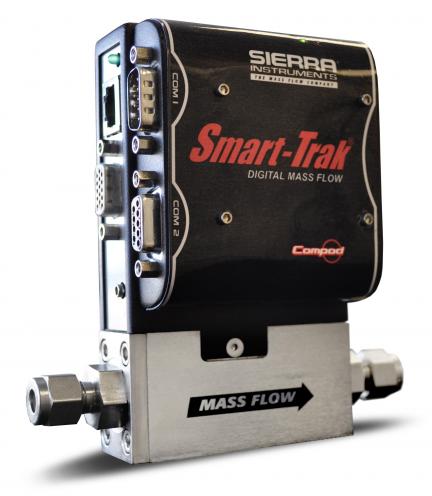
Compod Simplifies Flow-Control Installations

Sierra Instruments has released the Compod, its new programmable control module. The Compod, when coupled with Sierra's Smart-Trak mass flow meters (MFMs) and controllers (MFCs), simplifies basic flow-control installations and permits networking of multiple instruments using open-source Modbus RTU protocol. Adding the Compod module to a new or existing Smart-Trak MFM or MFC allows end users to take complete control.

Two digital outputs and one analogue input can be configured by the end user for a variety of process controls, including: gas mixing and blending; gas-ratio control; simple batch processes; triggering alarms; starting or stopping gas-flows automatically under user-defined conditions; and gas-flow totalisation.

Compod also monitors the functionality of the mass flow meter or controller and includes diagnostics, notifying users of faults or system updates. The Compod mounts to any Sierra Smart-Trak 100 Series, converting the instruments' internal RS-232 communications into multi-drop RS-485/Modbus RTU.

Modbus allows multiple instruments to be daisy-chained over a single network. When used with a PLC or master computer, each instrument equipped with Compod becomes a node on the Modbus network, capable of sending and receiving data and commands. Even complex process-control systems can be automated with the power of Compod and Sierra's Smart-Trak 100 Series.

Festo Introduces Multi-Axis Control Module

Festo has launched an intelligent multi-axis control module for electric drives. The CPX-CMXX module is a highly integrated unit designed for use with Festo's CPX series of multifunctional control terminals. It is suitable for parts handling and positioning applications such as pick and place, palletising, machine loading and unloading, inspection/measuring and labelling. The module can operate autonomously or in response to signals from a host controller - it features a built-in PLC-compatible interface.

It can store and execute simple individual axis movements, and can coordinate the movement of two groups of axes, each containing up to four axes. There are 1,024 position sets available for each of the two groups of axes; these can either be linked and executed in sequence, or multiple sets can be executed in synch. The module communicates with the various drive modules via CANopen, using the standard fieldbus FHPP handling and positioning profile.

All configuration, parameterisation and commissioning of the CPX-CMXX module is carried out using Festo's Windows-based FCT software. The motion control sequences can be programmed, but they can also be set up using parameterisation or teach-in, without the need for connection to a host controller. The module is equipped with a standard Ethernet 10/100 BaseT interface for parameterisation, as well as a service interface for a Festo CPX-MMI hand-held terminal, and features front panel LEDs to indicate program status and provide local diagnostic feedback.

A preliminary test of the entire system can also be performed without a host controller. Festo's CPX multifunctional terminals provide machine builders with a very flexible, modular approach to control, condition monitoring and diagnostics. The terminals can form part of centralised, decentralised and hybrid control schemes, and are compatible with all major fieldbus systems, as well as industrial Ethernet.

Individual modules can be changed at will, enabling systems to be reconfigured or expanded without altering the wiring. Festo produces a wide range of CPX-compatible modules, including intelligent analogue I/O modules for temperature sensing and signal detection, PNP and NPN digital input units, M12 and M8 connection blocks, and two types of position transducers for use with pneumatic actuators.

Optotherm HP20 Offers Precise Temperature Control

The Optotherm HP20 provides precise temperature control (+/-0.01C) of thermoelectric modules and heating/cooling stages within a temperature range of -40C to +250C. The HP20 operates in a bi-directional, H-bridge configuration for smooth transitions between heating and cooling cycles and provides output current of up to 20A at 12VDC. The HP20's PID capabilities are claimed to enable rapid response to changes in operating conditions and provide tight control over a broad temperature range.

TE View, the included PC-based software, provides an interface for configuring and operating the controller via the controller's serial (RS-232) interface. Once the controller is configured, the computer can be disconnected and the controller can be operated manually using the front-panel push-button interface. When the controller is connected to a PC, the set-point and actual temperatures can be plotted in real time, providing a temperature history that can be saved in ASCII text format and imported into data analysis programs. It features plotted temperature data and step-by-step instructions, facilitating the process of setting correct PID control parameters.

Switch-Mode Power Supplies For Automation Control

Balluff has introduced a line of rugged primary switch-mode power supplies, for automation-control applications. The ten-model line includes a range of 24V DC models with single and three-phase inputs. Output current ranges from 0.75A (18W) to 40A (960W) mean there is a size for most applications.

If more power is needed, multiple power supplies can be connected in parallel for additional current capacity. Other features include built-in advanced overload and overvoltage protection, load regulation to +/- one per cent, ripple/noise of less than 50mV on most models and adjustable outputs to compensate for differences in specific control needs.

All models are din-rail mountable. The mean time between failure is specified over 210,000 hours (24 years) while operating at published specifications. The range also includes 5, 12, 15 and 48V models.